Venues

Canapost, is a small village located at the foot of some low rolling hills, in the south-eastern nature reserves of the Gavarres. This village is made up of a small group of farmhouses built beside the parish church of Sant Esteve, one of the most significant archaeological monuments in the region.
Some other farmhouses scattered around also belong to this parish. In the village there is a beautiful road that leaves Vulpellac and leads to Peratallada and Ullastret. Canapost is separated from the village of Peratallada by the hill called ‘Puig d'en Torró’.
The most popular element of the town is undoubtedly the parochial church of Sant Esteve, which seems to have been previously dedicated to Saint Clet, the third pope.
.jpg)
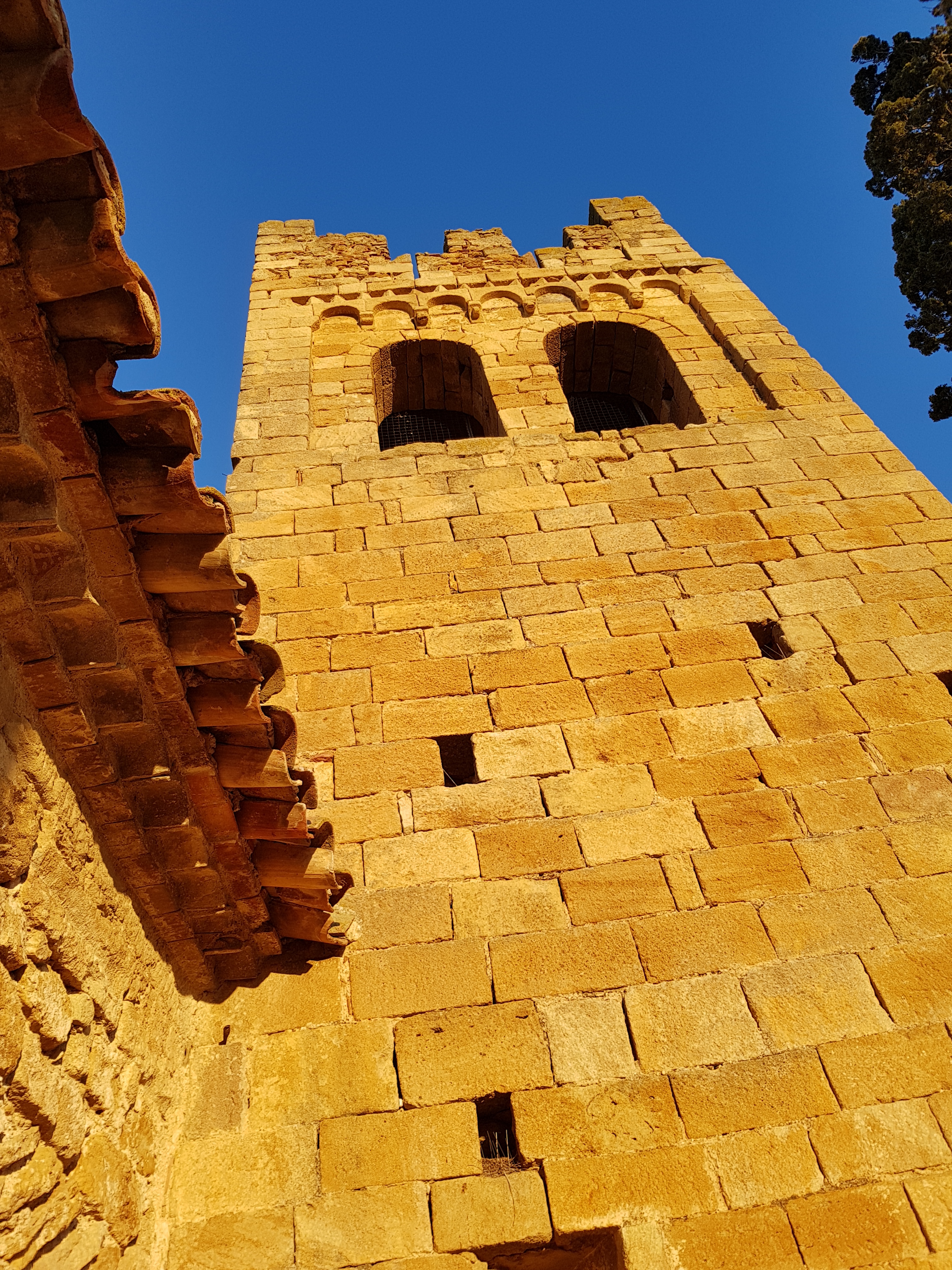
The present monument has different structures that belong to successive constructive stages. The church is made up of two juxtaposed buildings, one is pre-Romanesque and the other is Romanesque, with a bell tower, which is also Romanesque. The primitive temple nave has been preserved with few alterations, and has been classified in the pre-Romanesque period II. This magnificent building justifies a visit to Canapost.
The Canapost site is mentioned in a document from the year 901 under the name of Caneposto. In the founding of canonical life in Girona Cathedral, from the year 1019, it refers to a lodge in the parish of Canapost. The etymology of the place name has not yet been clarified. It has been said, however, that cana may refer to a milestone or stone on the path, on the assumption that it would coincide with the location of the place beside an old path.
In Canapost you can check the continuity of settlement, thanks to the various archaeological remains found, at least from the Roman period to the present day. Some remains of great interest have been preserved, such as the late medieval altarpiece or cist of the Mas Puig-sec - an asymmetric anthropomorphic hawk excavated on the rock that was pointed outwardly with vertical slabs - or the quarries known as the Clots of Sant Julià, which were probably operational at a time prior to Romanisation and during the Middle Ages, when it seems that a rock sanctuary was built. To the west of the quarries, near the Mas Ral, there is another archaeological pavement with Iberian ceramics. The traces of a section of what was once the old Camí d'Empúries, one of the main Roman roads that connected this villa with Girona, have also been preserved. On the other hand, in front of the church of Sant Esteve and the nearby farmhouses, remains of Roman settlements have been found. All of this is the object of great interest and architectural and archaeological appeal.
Another significant place can be found at Puig dels Socors.
.jpg)
On the north-eastern slope, remains have been found of pre-Roman settlements, just where the ruins of the chapel of Mare de Déu dels Socors are now found. This is a place that is highly recommended for visitors, especially for the view. Josep Pla described the place: «Els Socors is an excellent vantage point to contemplate this area of Romanesque land, a vivid medieval feeling and quality outstanding landscapes. From the hill we can see the walls and towers of Peratallada, Palau-sator, Boada, Pals, Castell d'Empordà, Llavià, among the lands of a divine grace.» The remains of the Mare de Déu dels Socors evoke the beauty and majesty of one of the most unknown temples of our architectural heritage. This singular chapel, dating from the 17th century, is located on the west side of Canapost, on the hill that gives it its name. It was all backed with a defence tower attached to the rear, and lost the roof and part of the stones that formed the openings, most likely as a result of a plundering. Despite its charm and value, it is a rather unknown element, which is not found in any of the tourist guides in the area. A visit is highly recommended, especially because of its privileged location, from which there are magnificent views. Josep Pla considered it one of the most privileged viewpoints of the Empordà.

This is a place located in the middle of the forest, in the heart of the Gavarres with a very special charm and personality.
With lush forests of cork oaks and pine groves and some clearings, it is a welcoming environment for walkers, cyclists, hikers and for everyone else passing by. It is a quiet place that is full of history and conveys a special magic. The beautiful landscapes, thanks to the views that can be seen on the plain and thanks to its personality, can only be perceived by someone who sees it in person.
The origin of the name of Fitor, which means landmark or term, in both its figured and real sense, is uncertain. Joan Botey, one of the largest owners of the area and a researcher of this place, maintains that it could come from the moment of maximum territorial splendour of the county of Empúries (9th century), in which the boundaries went from Corberes in Roselló, up to this mountain range. The name appears written for the first time in the year 948 at the time of the consecration of its parish, but it already appears as one of the founding towns integrating the present village. The settlement of the Fitor mountains is immemorial. In this area, there are a large number of megalithic monuments, close to each other, some of which are large, and evoke the presence of a culture that was very prevalent in our era.
In Fitor we can find the densest dolmen village in the Gavarres area, and one of the main ones in Catalonia.
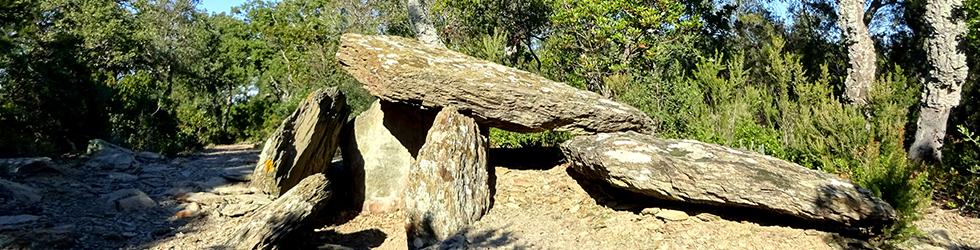
A significant number of these funerary constructions are still in a good state of preservation, made with large stone slabs, which show a good part of their original structure. In the area of Fitor there are fifteen dolmens, a menhir and several sacrifice stones. The best known are in the Serra de Cals, where the dolmen of Tres Peus, Tres Caires and the Serra de Calçó, are very well preserved, from which there are spectacular views of the Gavarres massif. Click here to see the routes of the dolmens in Fitor.
The most symbolic element of Fitor, apart from its forests, paths and streams, is without a doubt the church of Santa Coloma.
.jpg)
This is one of the jewels of the Gavarres massif, it is a Romanesque church that stands majestically on a small plain. The most singular and characteristic element of the building is its great bell tower, visible from most of the massif. The Lombard influence of Catalan Romanesque is presented in the decoration of the windows on the upper floor of the bell tower, with an arcade frieze. Together with the rectory and the cemetery, it forms a small group. The most milled roads are those that take you from Fonteta, Sant Climent de Peralta -where it connects with the Girona-Palamós motorway-, Mont-ras and Coll de la Ganga.
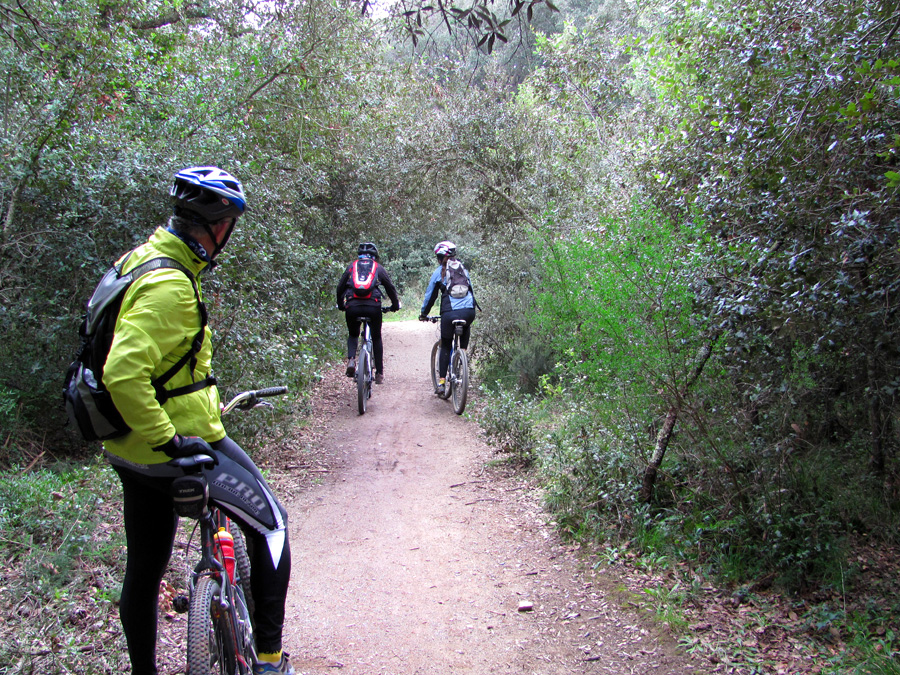
In addition to the historical and heritage value of the megalithic tombs and the church of Santa Coloma, Fitor, offers an unbeatable setting for practising activities related to active tourism: cycling, mountain biking or hiking. Fitor is a special place, especially for those seeking tranquillity

The village of Fonteta is located at the foot of the Gavarres massif. The hamlet forms a compact set of narrow streets around the parish church of Santa Maria.
Some of its streets still retain the ancient cobblestone and give it a characteristically rural aspect of a markedly Empordà town. It is crossed by the old road that linked La Bisbal with the coast, passing through the old neighbourhood of Fitor. This fact shows that Fonteta has been a strategic point in the area's communication network over the centuries. Prior to aggregation into the municipality of Forallac, the municipal district of Fonteta had an area of about 24 square kilometres, stretching along the north-eastern slopes of the Gavarres massif. It included a small rather flat sector, in contact with the Daró plain. The rest of the district was mountainous, and it reached the coll de la Ganga, which borders the towns of La Bisbal, Cruïlles and Calonge, to the northern slope of the Puig del Caragol, and to the south, the boundary with Calonge, Palamós and Vall-llobrega. It also included the towns of Fitor, the neighbourhood of Abellars and the old town of Torroella de Mont-ras. The fountain that gave its name to the town is the one that we can still find today on the same side of the church and that is still flowing. This fountain has been recently renewed and it has an inscription that explains the relationship between it and the name of the site. The rural village of Fonteta was donated by Carles el Calb to the Bishop of Girona in 844, along with another rural town called Apiliares, which is identified with the neighbourhood of Abellars. In 904, when Bishop Servusdei consecrated the parish of La Bisbal, he granted the tithes and the first fruits of the Church of Fonteta. The town belonged, later, to the barony of the Bisbal. From this municipality it managed to become independent in the second third of the nineteenth century.
The most singular and remarkable building in the village, apart from some houses of great historical and architectural value, is the parish church of Santa Maria, which was already known to exist in 904.
.jpeg)
The current temple preserves the Romanesque nave, from the 11th century, which was later modified. The Romanesque apparatus can be seen on the western façade, where a Renaissance door and a rose window were opened. The temple has recently been refurbished. The houses of the village are from the 16th and 17th centuries, with vaults in the lower parts and embedded in the floors, thresholds with inscriptions and dates. The streets are narrow, well-arranged, and all of them give an air of a very traditional rural town. The economy of the town has been closely linked to the exploitation of natural resources and agriculture. The population has traditionally lived looking towards the Gavarres and working the fertile lands of the plain. From this direct story there are many testimonials, such as lime kilns, which are very characteristic throughout the municipality.
Located in the heart of the Baix Empordà and in the interior of the Costa Brava, the village is in a place that has charm and personality and in an unbeatable setting for practising activities linked to active tourism because it is at a point of departure and arrival of several routes for cycling and hiking, one of them is the well-known one as the route of the dolmens of Fitor.

In the middle of the heart of Empordà and just a few kilometres from the best coves and beaches of the Costa Brava, the village of Peratallada is located in the province of Girona, halfway between Barcelona and the French border.
The ease of access, the good weather, the uniqueness of popular events, the richness of the historical and cultural heritage and the wide range of activities offered by the area make the village of Peratallada an ideal place to spend a good holiday be it as a couple, with friends, with family or individually. Apart from its architectural and historical attractions, the town is renowned for its significant artisan and, above all, gastronomic offer. The alleyways of the village are full of numerous and suggestive restaurants of all kinds, which offer the perfect complement to a visit to the village.
(1).jpeg)
A historic-artistic and cultural centre of national interest
The village, declared a historical-artistic and cultural centre of national interest, is one of the most important villages of Catalonia in terms of medieval architecture. With extraordinary appeal and beauty, it preserves its ancient feudal appearance, with narrow and tortuous streets and numerous entrances and alleyways. The route through the town allows you to discover different points of view of the castle-palace and the walls and various popular architecture. The whole town is located on sandstone rock, worked in various ways. There is no doubt that the most impressive elements are the wall valleys, with trenches excavated into the live rock.
.jpg)
Therefore, the meaning of the name of Peratallada, remains obvious to those who visit the population (the noun is formed by ‘pedra’ + ‘tallada’, which literally mean ‘stone’ + ‘engraved’). Peratallada was one of the most fortified Catalan populations. The defence system was formed by three walled enclosures (the main one with the castle at the centre and two others that were to the north and east) protected by the trenches excavated in the rock of unknown and debatable chronology. Where it is currently visible, they are about 7 or 8 meters deep. The highlights are the fortified castle with its tribute tower and the palace (11th-14th C.), the walls (12th-13th C.) and the church of Sant Esteve (Romanesque at the beginning of the 13th century). Also worthy of note is the great moat that surrounds the town, excavated into the live rock. The whole town is seated on sandstone rock, worked in various ways. A curious fact, and one that is worth noting is that Berenguer de Cruïlles (1310-1362), bishop of Girona and the first president of the Generalitat de Catalunya, was a native of this town.
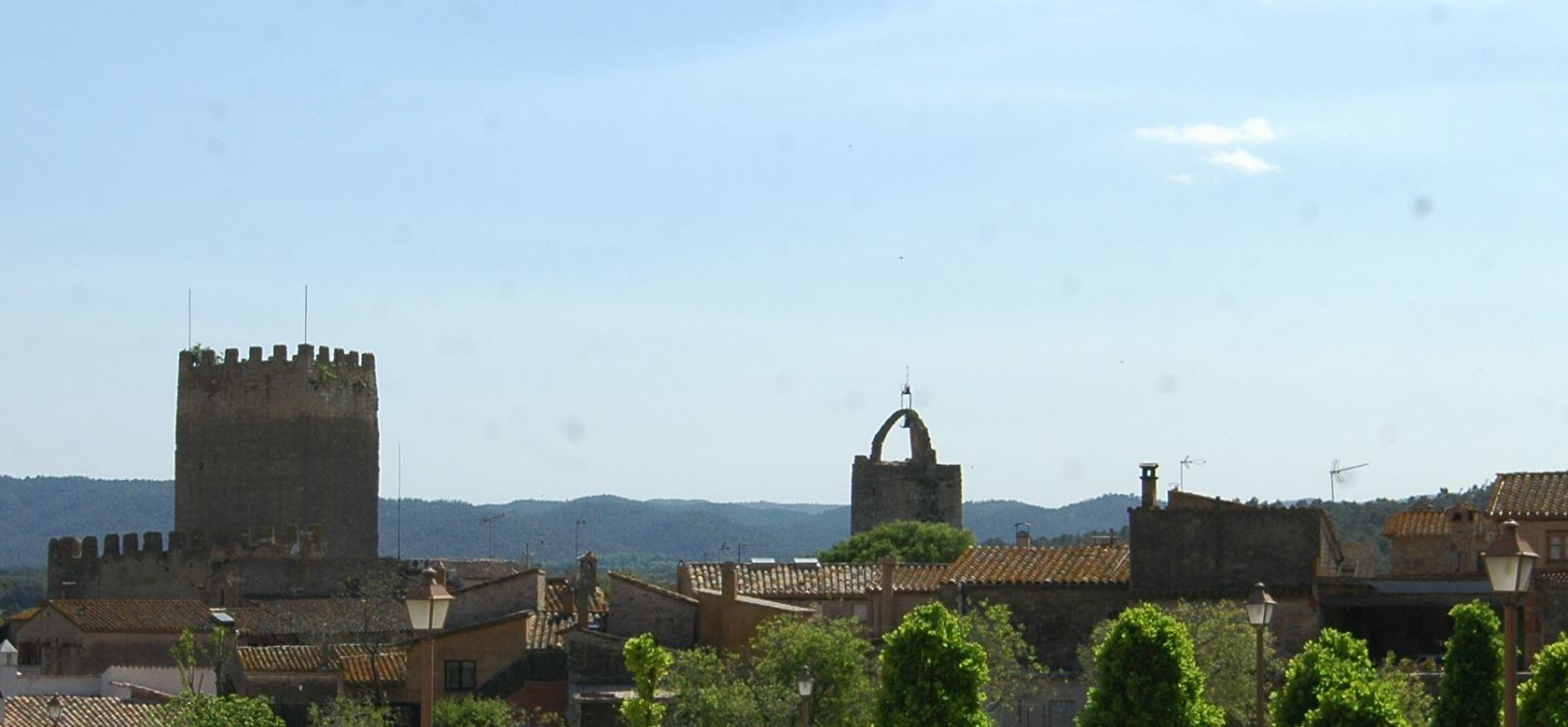
The castle of Peratallada, around which the town settled, was the centre of the barony that belonged to the aforementioned lineage of Peratallada, documented from the 11th century. The castle has been proved to have existed in 1065, but some architectural structures seem to show that this village already had an even older fortress. The fortified village is raised above an enormous rocky base of natural sandstone, artificially cut to give it verticality.
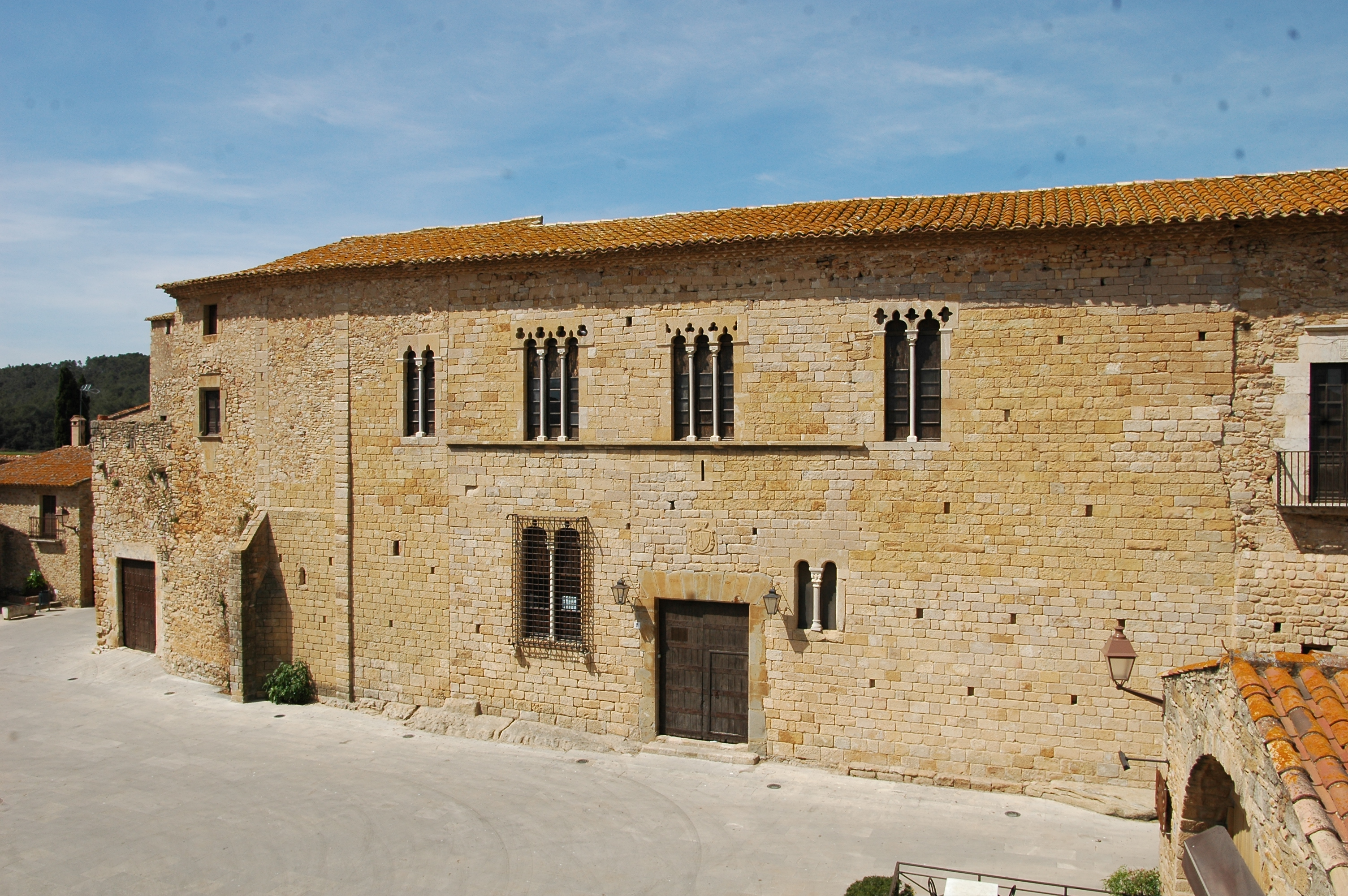
The rocky mound rises 4 or 5 meters above the surrounding terrain. On top of it stands the great castle, with its characteristic tribute tower, and the magnificent palace, oriented to the east, that faces the Castle Square. Also you can see remains of battlements (spaces to defend itself between the solid stone) that give great attraction and mysticism to the construction. The high tribute tower, the identity landmark of the town, is rectangular and crowned by square battlements. It has a sloping door and had an intermediate wooden floor. It is constructed with rows of squared ashlars.
Petra scissa or Petra Tallada
The place name Petra scissa or Petra Tallada is documented, apparently, from the 10th century. Later on, the name refers to a few modifications to the people or to the different characters of the Peratallada lineage, which eventually became one of the most significant in the Baix-Empordà roots. Thus, for example, in 1062 there is mention of a Bernardi de Patra Taliada, in 1065 Castro de Petra Taliata appears. In 1088 we find Petrataliata, 1111 Petra Taliata, 1112 Petra Talata, 1128 Petra Incisa and Patra Taiata, 1143 Petra Tayada, 1169 and 1173 Petra incisa, 1202 and 1222 Petricissa, etc.

The village of Sant Climent de Peralta originates from the old monastery located in a small, narrow valley of Les Gavarres, in the vicinity of the tramuntana. No so long ago - 18th C. - the church of the old monastery was abandoned and the new parish was built, about two kilometres to the east, in the nature reserves of the mountain range closest to the plain, where the population of country houses moved to, characterising the location. Sant Climent had to be, as Pella and Forgas indicated, one of the first monastic, Benedictine colonisations of the country.
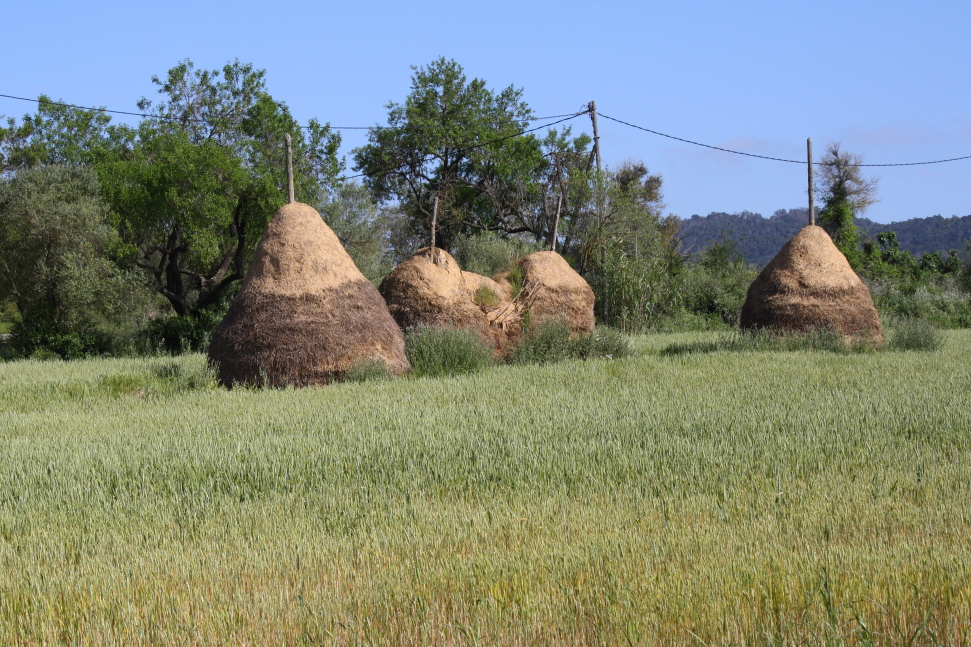
The monastery was placed in a hidden corner, in the valley of a ridge with slopes staggered over cultivated terraces and near to a fountain, which has now almost stopped. Lets imagine that in the high-medieval era the place would have been even more shady and would have had more scrambling vegetation than at present. It seems that this site was populated before the monastic establishment. The tiles that can be seen between the walls of the church ruins may come from a building from Roman times. However, remains of a necropolis with tombs protected with tegula have been discovered that could be prior to the first documents that tell us about the monastic cell.
The ruins of the church of the monastery of Sant Climent de Peralta are known by the name of the old church of Mas Vidal, a 19th century house, that is currently inhabited. This was to be built with most of the stones from the demolition of part of the church, and perhaps from other medieval buildings that had disappeared.
The inhabitants of Sant Climent de Peralta have traditionally been living from the fields and the exploitation of the natural resources of the Gavarres massif: cork, firewood, coal, etc ... The town farmhouses thrived with the exploitation of cork. Then, when the vines in France were attacked by phylloxera, much of the farmland was transformed into vineyards. Currently, the settlement is made up of dozens of farms, some of them converted into second homes.
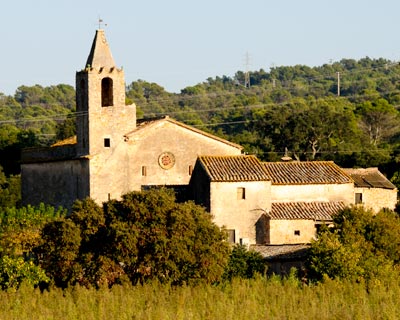
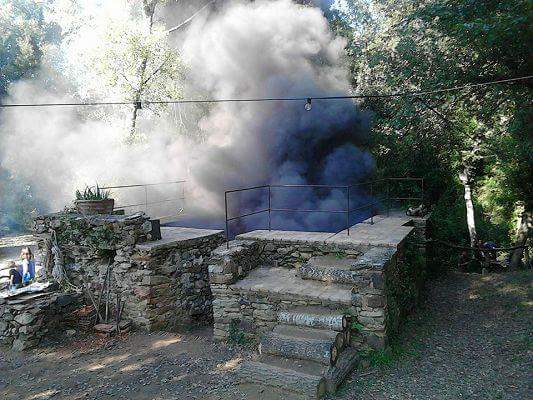
Sant Climent de Peralta's church
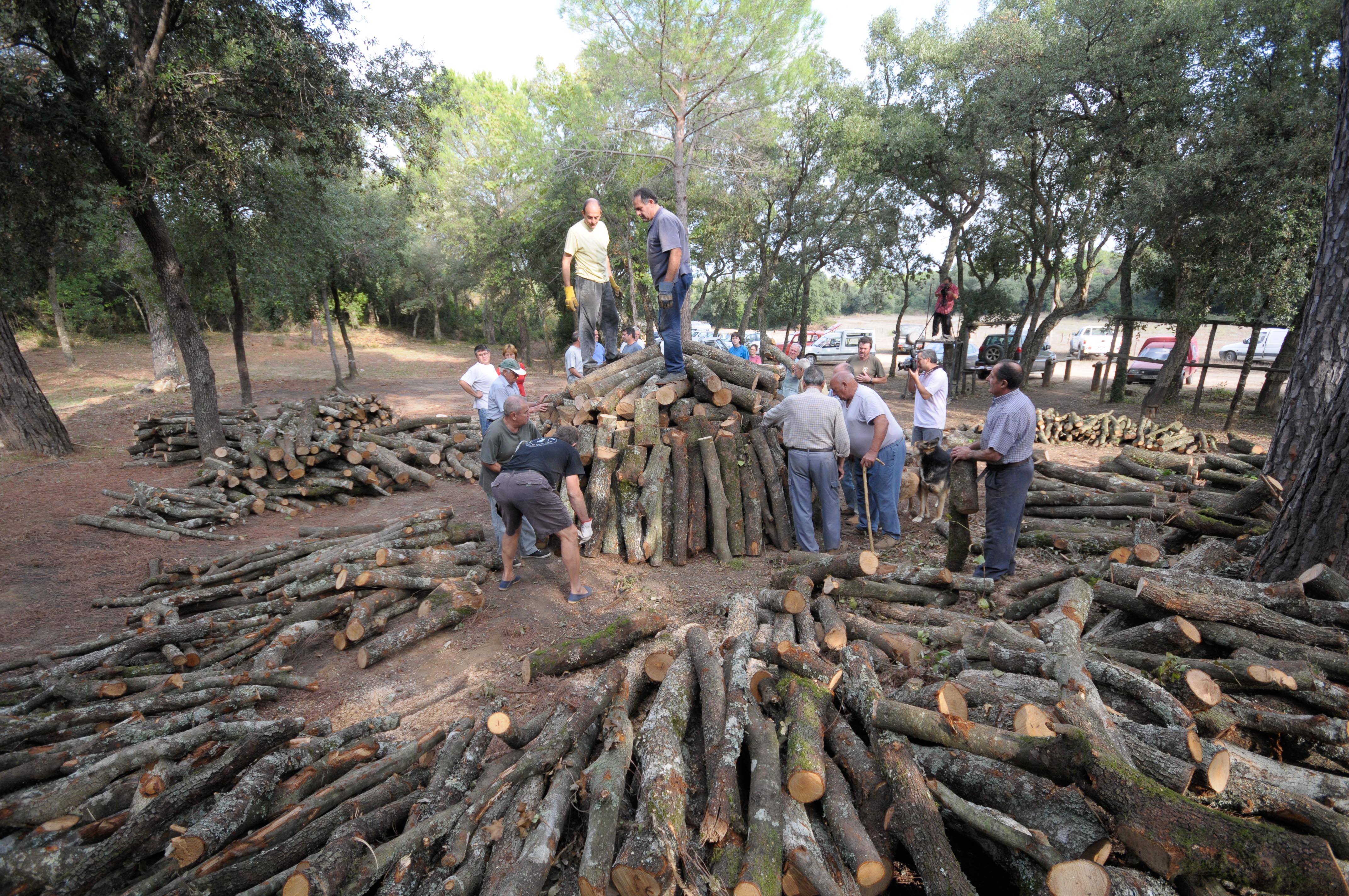
La Carbonera
La Rajoleria del Mas Frigola
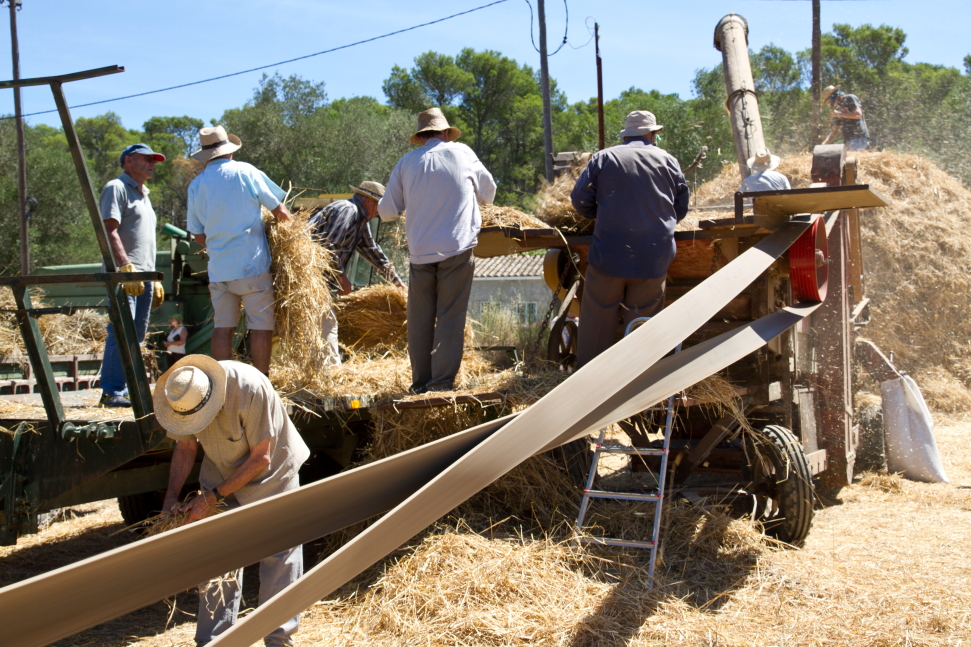
Festa del segar i del batre
In Sant Climent, however, it is still possible to breathe the atmosphere belonging to a place that is closely linked to the massif. The village has some of the most beautiful and enchanting places of the Gavarres, which make it an excellent place for hiking and discovering the natural environment of this important space.
How to get there

The district of Santa Susanna de Peralta is located at the south-western end of Peratallada and borders on Sant Climent de Peralta, taking as reference the current route of the C-255 road from Girona to Palamós.
The settlement of the district is made up of various farmhouses, some of them converted into second homes. Traditionally, the population has lived through field farming.
In the land of Santa Susanna there are the remains of a bakery that is considered pre-Roman -Iberian- by the few pieces of pottery that, very crushed and eroded, were found on the outskirts. Currently, these remains, which are located a short distance from Can Serra, near a quarry in disuse, are virtually destroyed.
In the fields and forests near the castle, fragments of Roman type and Iberian-Roman ceramics were found. The scattering and low abundance of these superficial, sporadic findings, do not allow us to locate, not even roughly, the place or places where the old settlement was established.
The church of Santa Susanna de Peralta is located about 200 metres north of the castle, in a hollow beside the right bank of the Peralta stream. It is a small Romanesque temple, of extraordinary beauty, that has a single nave with a semicircular apse that was the subject of remarkable reforms in the 17th and 18th centuries. It is in a good state of conservation thanks to the significant restoration that took place in 1976 and 1977. The apse is decorated with Lombard slats or lashes, and has a double-bottom window and rounded arches.
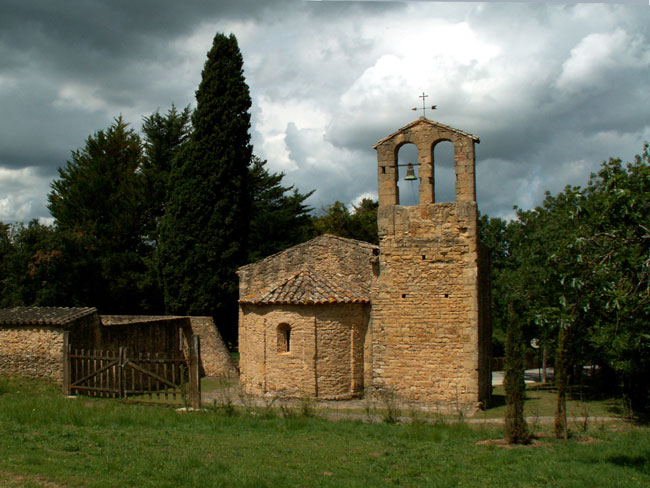
At the north side of the temple, at the far end of the nave, there is a square-bell tower that was unfinished or partly demolished. At the moment only the bottom part remains up to the height of the cover of the nave. On the east wall of this tower a bell tower was built with two rounded arches on rectangular pillars, also Romanesque. The interior of the bell tower is connected to the nave by means of a mid-point arch, from the baroque period.
How to get there

The town is made up of an old town with remarkable architectural interest, which is structured around the elements that make up the castle-palace and the parish church of Sant Julià and Santa Bassilissa. The old town was declared in 2009 by the Directorate General of Heritage of the Generalitat as a cultural asset of national interest in the historical group category.
The elements conserve a good part of the characteristics that are typical of the medieval Catalan towns. According to the text from the Government's agreement, the town "articulates throughout its grounds, a series of routes and spaces of architectural interest that invite contemplation and intrigue through the old town of this municipality", which "makes the integration and preservation of these historic elements especially necessary".
.jpeg)
The old municipality of Vulpellac covered, before the annexation with Fonteta and Peratallada, 4.29 square kilometres. The district comprises a hilly area, on the west and north east with the highest point in the puig Negre (109 meters high), which is part of the Serra de Sant Ramon, a limit with the neighbouring district of ??La Bisbal d'Empordà. The remaining part is flat and drained by the Fonteta stream, from the Daró basin, which descends from the Gavarres. The road from Palamós to Girona, through La Bisbal, crosses the municipal territory from east to west. At the point where this road crosses through the town of Vulpellac, the local road that goes to Pals begins and passes through Canapost, Peratallada and Palau Sator. As in so many villages of the Empordà, a good number of houses have been converted into second homes and restored respecting the property values ??of the buildings. Outside this village there are numerous farms spread across the neighbourhood of the plain and somewhat throughout the district, which has two other significant populated areas: the neighbourhood of La Bordeta, which emerged in the nineteenth century along the Girona road, and the urbanisation of Puig de Sant Ramon.
Due to its location - along the road from Girona to Palamós and La Bisbal -, a large number of industries have been installed in the district, mainly related to ceramics or artificial stone. In order to consolidate and give order to this industrial potential, the urbanisation of the industrial estate began in 1999, where Nexes is now found, the nursery for Forallac companies, created with the aim of boosting the economy of the township. It is a facility for the temporary location of small businesses so that entrepreneurs have at their disposal a set of services at an affordable price that facilitate the operation of their company during the first years of its start-up.
How to get there

As the name suggests, the Bar del Poble serves the people of the village but also anyone who wants to have a drink, a vermouth, taste a good coffee, a sandwich or a delicious artisan beer. It is located in the Plaza del Castillo de Peratallada, in the village's social centre and shares the space with the Tourist Office of Peratallada. In the summer you can enjoy the fresh air on the outside terrace, contemplating the majestic views of the castle and in the winter, there is a giant screen to watch football matches. Open all year.
Local Bar
Plaça del Castell, 3
17113 Peratallada
Phone number: 872 01 50 17

Cala Nena is a cosy and original restaurant located in the incomparable setting of the medieval village of Peratallada, in the middle of the Les Voltes Square. With a gastronomic offer where fresh market produce is the main ingredient, they offer a culinary proposal that is tailor made for sharing and enjoying the best flavours on the table. Cala Nena offers you a different and unique way to celebrate family and business meetings.
Cala Nena
Plaça de les Voltes, 11
17113, Peratallada
Phone number: 972 63 48 03 / 630 00 10 00
E-mail: calanenaperatallada@gmail.com

Located in the old family property, this is a rural house in the Empordà style dating back to the 18th century, with three small and cozy dining rooms, which complement the largest dining room and a pleasant outdoor terrace. The rustic furniture, the decoration with paintings and drawings by local painters are part of its small history and a nice log fire gives it a warm atmosphere that you will find throughout the year. Its cuisine is characterised by the simplicity of the authentic Empordà’s cuisine.
Can Nau offers different dishes from the menu, seasonal dishes and Pals rice menu.
Restaurant Can Nau
Plaça Esquiladors, 2
17113 Peratallada
Phone number: 972 63 40 35
E-mail: restaurantcannauperatallada@gmail.com
Website: www.restaurantcannau.blogspot.com

Located in an old stone house in the heart of the charming village of Peratallada, the Restaurant Candelaria was opened in 1995. A short time later, in 1998 it came into the hands of the owner Anahí Metola who after twenty-five years transferred it to Santi Salvadó the current manager, who opened it in 2019 with a new name: DO Candelaria. Along with him, begin Nacho, the chef, an engineer who stopped practicing to make his hobby his profession, and his wife, Marta, who is in charge of the room, who also decorates the walls of La Candelaria with her works. Two years later they take over and continue the project, fulfilling their dream, take over the reins of a restaurant in the Costa Brava.
With the special decoration of the DO Candelaria, the aim is to create a cozy and relaxed atmosphere offering to the client an attentive and friendly service. With this philosophy of work, both in the kitchen and in the dining hall, DO Candelaria Tapes becomes a place that evolves and grows and that it set the bar a little higher every day and it is happy to do so.
Restaurant D.O. Candelaria
C/ Major, 9
17113, Peratallada
Phone number: 972 63 41 81/ 635 30 39 11
Website: www.docandelaria.com

Restaurant El Borinot
C/ del Forn, 15
17113, Peratallada
Phone number: 872.99.37.48

This offers very careful cuisine based on quality products. It consists of a large patio, surrounded by natural rock, walnut trees and a great diversity of plants, which create a very pleasant environment where you can enjoy a good meal. It also has cosy interior rooms.
El Pati
Carrer Hospital, 13
17113, Peratallada
Phone number: 972 63 40 69
E-mail: peratallada@hotelelpati.net
Website: www.hotelelpati.net

L'Eixida is a signature cuisine restaurant with a committed to the tradition and the avant-garde. This is a fun and thoughtful gastronomic offer specially thought for sharing. Through their kitchen you will discover local products and the passion for a job well done.
L'Eixida Restaurant
Carrer del Forn, 4
17113, Peratallada
Phone number: + 34 972 63 48 06
E-mail address: info@leixidarestaurant.com
Web site: www.leixidarestaurant.com

La Roca is a restaurant located in an old manor house that has been restored and adapted to offer a familiar, warm and cosy atmosphere, aspects which are linked to its cuisine: a home-made but careful style that can delight the most demanding palates. Its location and decoration, complemented by the careful, native and quality cuisine, is capable of taking us back centuries and permeating us with the much desired privileged nobility. The restaurant La Roca offers the possibility of being seated on fresh terrace or the pleasant interior, and being able to enjoy the cuisine of Miquel, who has been a cook for more than 30 years and is the restaurant owner.
Restaurant La Roca
C/ de la Roca, 8
17113, Peratallada
Phone number: 972 63 41 42
E-mail: info@restaurantlaroca.cat
Website: www.restaurantlaroca.cat

The Pou Dolç restaurant, which does home-made cuisine, is located in Les Voltes Square. In addition to a restaurant service, there is a bar with an outdoor terrace where you can refresh the summer nights with the already popular "mojitos" or "caipirinhas" among others.
Pou Dolç
Plaça de Les Voltes, 11
17113, Peratallada
Phone number: 972 63 40 15

Pati Pizza is a terrace located in a picturesque courtyard with large trees and a good atmosphere. Emporda-inspired Neapolitan pizza with home-made dough and a fermentation of more than 24 hours.
Pati Pizza
Carrer Mas Bou, 4
17113, Peratallada
Telèfon: 663 05 29 61
E-mail : lajornaleracuinaestacional@gmail.com

La Vermuteria is a venue located in the emblematic Plaça de les Voltes in Peratallada. It offers a relaxed and welcoming atmosphere, ideal for enjoying a vermouth, having a drink, or sharing an informal meal. Its offer combines a selection of beverages with tapas and dishes to share, in a charming setting that invites you to relax and enjoy the surroundings.
La Vermuteria
Plaça de les Voltes, 7
17113, Peratallada
Telèfon: 972 63 48 68

The current restaurant is classic kitchen cooking. Throughout the whole year, you can try different rice dishes from Pals, fresh fish, prawns from Palamós and grilled meats braised with charcoal. Home-made dishes, mushrooms and game cooking with wild boar and partridge in autumn and winter. Of course, the “calçots” (grilled spring onions), they are the pioneers of serving them in Girona. You can find them from January to March. In short, careful seasonal cuisine, which combines the quality of traditional foods, with traditional cuisine, which does not hide the avant-garde of the Restaurant and the Winery. They have the speciality of “cargols a la llauna” (seasoned and cooked snails), available all year round. With regard to the facilities you will find several dining rooms, two with fireplaces and halls for groups and celebrations. For summer lunches and dinners, there is a terrace where you can also take a break during the rest of the year for a glass of something, a coffee or simply a breath of air. In addition to the restaurant, the space has the Celler de la Masia, an old restored winery and its gardens for weddings and celebrations.
Restaurant La Masia
Ctra C-66 Km 5.5
17110, Sant Climent de Peralta
Phone number: 972 63 40 58
E-mail: lamasia@restaurantlamasia.net
Website: https://www.restaurantlamasia.net/

Speciality in home-made cooking, sandwiches and tapas. Daily menu from Monday to Saturday.
Bar Restaurant El Pas
Carme Carles, 31 Baixos
17111, Vulpellac
Phone number: 972 64 00 04

Can Nentia is a Rural Tourism house where the hospitality of the old farms is recovered, with spacious rooms, cosy corners, in front of a landscape at the foot of the Gavarres, which gives off the tranquillity of living in a privileged location. The house consists of two floors; on the ground floor, there is a very large entrance, a washbasin, a charming patio, the dining room-living room, a large kitchen with a dishwasher and a magnificent fireplace, where you can enjoy the pleasure of making a typical toast with spread tomato or “allioli”(garlic mayonnaise), or delicious grilled meat, with that oak charcoal scent, roasted vegetables, cargols a la llauna... And what do you say about those wonderful, almost forgotten gatherings of folk by the fireside? Spending time, with friends, family, sharing ... In the upper part, divided into two spaces, there are four spacious rooms, one double and one triple, each with a bathroom, and one triple and one single with a shared bathroom. There is heating throughout the house and it can accommodate up to nine people.
Can Nentia Rural Tourism
Carrer de l'U d'Octubre, 22 Fonteta
Phone number: 972 630 477 / 679 007 552
Registration code: PG-000325
E-mail: info@cannentia.com
Website: www.cannentia.com/

Jardins de l'Empordà is an exclusive farmhouse formed by the Botanic Garden, Les Vinyes, the Celler Mas Patiràs and the Masia Vinyes de l'Empordà, an 18th century house that retains the charm of an Empordà farmhouse, located near the village of Fonteta. The house, apart from its charming rooms, offers common areas where you can enjoy reading, the wine or swimming in the pool. The name comes from the lack of water they experienced long time ago, which caused great headaches to the tenants. Today, however, the surroundings have turned into botanical gardens of great wealth and attraction to tourists in the Empordà area. The Torrent de Fonteta family has also cultivated the vineyard and elaborated wine for the last three hundred years. At the moment, their wines belong to the Empordà Denomination of Origin. Total capacity: 8-10 people.
Vinyes de l'Empordà - Rural Tourism
C/ Afores, s/n
17110, Fonteta
Phone number: 606 354 865
Registration code: PG-000792
E-mail: info@vinyesdelemporda.com
Website: http://vinyesdelemporda.com/cat/

Mas Generós is a sustainable accommodation located in a unique place in the Baix Empordà, Fonteta. An ideal place for a getaway, to enjoy nature and the outdoors, where the slow weather and a sweet calm renews us.
Mas Generós
Sant Generós, 21
17110, Fonteta
Telèfon: 972 19 55 93
Codi de registre: HG-005014
Correu electrònic: masgeneros@masgeneros.com
Visita la seva pàgina web aquí: www.masgeneros.com

The Ca l'Aliu Rural Tourism house has 7 rooms, each with a full bathroom, air conditioning and Wi-Fi service. All of them with heating, television and hair dryer. Breakfast service is always included. Our clients have at their disposal a fully equipped kitchen and dining room as community spaces. Ca l'Aliu customers have free parking in the municipal parking lot. The house is located in the pedestrian area of Peratallada right in the center of the town, climbing a stone street still with the marks of the cars, which takes us back to ancient times. Ca l'Aliu is an ideal vacation space for lovers of tranquility and rest. Ca l'Aliu also has a terrace with a porch and a very spacious garden, with flowers, tables and comfortable chairs to enjoy the outdoor space. Total capacity: 20 people.
Ca l'Aliu - Rural Tourism
Carrer de la Roca, 3
17113, Peratallada
Phone number: 972 25 46 46 / 623 36 71 64
Registration code: PG-000142
E-mail: contacte@calaliu.com
Website: www.calaliu.com

Ca l'Anguila is a country house or farmhouse built in 1823, restored, surrounded by fields and forest, located 300 metres from the small medieval village of Peratallada, and dedicated to the agricultural exploitation of dairy cows and all kinds of farm animals: ducks, hens, rabbits ...
The house has two large dining rooms, one of them with a fireplace and a living room, decorated in a traditional rural style. In them you will be able to enjoy yourself chatting quietly with your friends, reading by the fire, watching TV ... There are 9 rooms (6 double and 3 single), all equipped with their own bathroom, TV and heating and air conditioning according to your needs. Thanks to the interior and exterior terraces, you can enjoy the nature and tranquillity of this incomparable corner of the Baix Empordà in the heart of the Costa Brava. Ca l'Anguila also has a large covered patio with benches and table tennis.
Total capacity: 15 people.
Ca l'Anguila Rural Tourism
Mas Geli, 1
17113, Peratallada
Phone number: 972 63 41 13
Registration code: PG-000176
E-mail: info@calanguila.com
Website: www.calanguila.com

This house has a history of more than 100 years and in 1930 it was already the first tavern of Peratallada. It has 6 rooms with their own bathrooms, a patio with a garden, an inner living room and a full kitchen for the guests. Breakfast is served every morning from 9:00 a.m. In Can Solés, you will be able to enjoy a peaceful and pleasant atmosphere away from the usual noise and tension. Surrounded by an incomparable nature setting, Can Solés is the ideal prescription for all those who wish to enjoy the tranquillity in an unbeatable atmosphere. Total capacity: 12 people.
Can Solés - Rural tourism
Torre, 1
17113, Peratallada
Phone number: 972 63 41 63
Registration code: PG-000127
E-mail: info@cansoles.com
Website: www.cansoles.com/cat/la_casa

Casa Mabi is a restored rural house located in the heart of the old town of the town of Peratallada. It has four rooms with views of the town. On the ground floor there are two living rooms with a fireplace to relax in, a nice dining room under a large window and a fully equipped kitchen. On the first floor are the rooms, all air-conditioned and with private bathrooms. On the second floor there is a games room and the rooftop with the outdoor swimming pool, where you can enjoy outdoor activities and a good bathroom. Total capacity: 10 people.
Casa Mabi - Rural tourism
Carrer Major, 14
17113, Peratallada
Phone number: 972 49 80 30
Registration code: PG-000907
E-mail: info@naturaki.com
Website: https://www.naturaki.com/casamabi

Hostal Blau is a hotel located on one of the narrow and rocky streets of the village: el carrer del Forn. The 16th century house, restored to adapt it to the present time, surprises everyone with its originality, without leaving behind the years that were lived within it. Decorated in colour, clear and dark blue predominates, and the golden ochres of the sun-baked fields in the summer skies, make known to our visitors the complicity in each corner so they can feel at peace where they are, you can tell they don’t want guests to feel like slaves to time. Total capacity: 14 people.
Hostal Blau
Carrer Forn, 2
17113, Peratallada
Phone number: 972 63 41 85
Registration code: HG-002294
E-mail: hostalblau@hostalblau.es
Website: www.hostalblau.es/es

If you pass by Peratallada, do not hesitate to enter the Hostal la Riera. La Fonda is located in a 15th-century farmhouse. It is a very important manor house in the village, where each bedroom is a world where you will find vintage furniture and precise decoration. The hostel offers eight exclusive rooms, fully equipped in this unique rustic and rural atmosphere.
Total capacity: 16 people.
Hostal La Riera
Plaça de les Voltes, 3
17113, Peratallada
Telèfon: 872 99 40 63 / 624 49 85 68
Registration code: HG-002236
Correu electrònic: lariera1997@gmail.com
Visita la seva pàgina web aquí: https://www.lariera.es/

On the outskirts of the medieval village of Peratallada, surrounded by farmland and woodland, the hotel has fourteen rooms. It also features a spacious terrace and fireplace, a bar, lounges, free Wi-Fi and free parking. Two meeting rooms with a capacity for 20–70 people, suitable for seminars and conventions. The hotel also has two saltwater swimming pools and is surrounded by extensive gardens and terraces. Adults-only accommodation (+14 years). Total capacity: 30 people.
Hotel Aatu ****
Afores s/n
17113, Peratallada
Telèfon: 617 464 914
Registration code: HG-002241
Correu electrònic: info@hotelaatu.com
Visita la seva pàgina web aquí: www.hotelaatu.com

The Hotel El Cau del Papibou is located in a building dating back to the 12th century. At the Hotel, you will be able to enjoy elegant bedrooms, newly renovated in an original and fresh style, and with all the comforts you might want. The Hotel El Cau del Papibou is a unique place to feel the history from the heart of the Empordà itself. In your room you can enjoy a 32” television, or check your emails through the Wi-Fi network. You can have a drink in the patio of the restaurant, relax in the reading room or take a walk on the ancient cobblestone alleyways before dinner.
You may wish to have some typical cold meats from the area for breakfast with toasted crusty bread or freshly baked pastries in the old Plebeus Square, a tasting dinner with the large wine jar from the old kitchen... There is room for all the possibilities in The Hotel El Cau del Papibou in Peratallada.
Total capacity: 16 people.
Hotel El Cau del Papibou ***
Carrer Major, 10
17113, Peratallada
Phone number: 972 63 47 16
Registration code: HG-002267
E-mail: info@hotelelcaudelpapibou.com
Website: http://hotelelcaudelpapibou.com/

This is a Catalan house from the 18th century, located in the centre of the village of Peratallada, surrounded by the natural stone wall, the bell tower, the tower of the hours and the castle. It has been carefully restored and decorated in the traditional Catalan style for its use as a comfortable and cosy hotel. Total capacity: 10 - 12 people.
Hotel El Pati **
Carrer Hospital, 13
17113, Peratallada
Phone number: 972 63 40 69
Registration code: HG-002275
E-mail: peratallada@hotelelpati.net
Website: www.hotelelpati.net


The Mas Rabiol hotel is a 16th century farmhouse in the heart of the Baix Empordà, two minutes away from the Bisbal d'Empordà, the capital of the region. With big stone walls, during its restoration, they wanted to retain its original essence and structure. It is a refuge where you will find nice people, a good rest (memory foam cushions and mattresses), silence, peace and a spectacular countryside breakfast. It has eight rooms each with its own character, decorated with reference to the nature that surrounds the place.
In their project, Gloria and Carlos want travellers to rest and find their inner-selves. Enjoy the beautiful and magical landscapes of the Empordà and disconnect, even for a few hours, from the hectic and stressed life of today. They welcome you into their home, which becomes yours from the moment you arrive, so your stay will be unforgettable. Mas Rabiol has a lounge in the upper area available for multiple purposes: conferences, courses, meetings, exhibitions, etc.
Total capacity: 16 people.
Hotel Mas Rabiol ***
Ctra. C-66 La Bisbal a Palamós Km. 6,5
17113, Sant Climent de Peralta
Phone number: 972 63 42 96
Registration code: HG-002354
E-mail: info@masrabiol.com
Website: www.masrabiol.com

The ensemble of Sant Climent de Peralta is in the municipal district of Peratallada, in the municipality of Forallac. It is made up by the church and The Rectory, which date from 1750 and have been adapted as rural tourism accommodation, respecting the original appearance, and a beautiful wooden house called "Ca la Heidi". The Rectory has room for up to 15 people, and Ca la Heidi, for 4 or 6 people with a sofa bed. The houses can be rented together or separately. The maximum total sleeping capacity of the houses together is 21 people.
La Rectoria de Sant Climent - Rural Tourism
Ctra. C-66 La Bisbal a Palamós Km. 5
17110, Sant Climent de Peralta
Phone number: 669 32 21 61
Registration code: PG-000683
E-mail: info@larectoriadesantcliment.com
Website: www.larectoriadesantcliment.com

Recuit de Fonteta is a registered trademark with a quality denomination granted by the Consell Comarcal del Baix Empordà under the name Product de l'Empordà.
Recuits de Fonteta
Carrer de Fitor, 2
17113, Fonteta
Phone number: 972 64 14 48
E-mail: quimmartell@hotmail.com
Website: http://www.recuitsfonteta.com/rf_cat00.htm

In Abricoc, you will find a selection of products from our region, you will can discover, buy or taste them.
Abricoc
C/ Constitució, 6
17110, Fonteta
Phone number: 699 96 48 84
E-Mail address: hola@abricoc.com
Siite web: www.abricoc.com

Mas Eusebi is a family farming dedicated to dairy cows. The product offered is pasteurized whole milk which is packaged in a closed circuit in the same farm. They distribute it in one liter bottles and in bags with lids, 5 liters and 10 liters. They are part of the Cooperativa Agrícola de Baix Empordà.
Mas Eusebi - pasteurized whole milk
Camí de Fonteta a Fitor, s/n
17110, Fonteta
Phone number: 628 539 165
E-mail adrress: lletfrescamausebi@gmail.com

La cervesa Fondi es produeix i s´envasa a la propietat del Mas La Caseta, a Fonteta. Una masia catalana on es segueix la tradició agrícola i a més elabora un producte derivat de la terra que l´envolta. Les maltes autòctones i la situació rural donen un caràcter particular a aquesta cervesa.
Fondi cerveseria artesana
Mas la Caseta
17110, Fonteta
Telèfon: 616 23 69 95
Correu electrònic: info@fondicmc.com
Visita la seva pàgina web aquí: www.fondicmc.com

Cal Tuset's muffins have personality, they are consistent, fluffy and their fillings are tasty and of high quality. Made with 100% natural products.
Cal Tuset- muffins
Plaça de l'Oli, 1
17113, Peratallada
Phone number: 619.289.639
E-mail address: comandes@caltuset.com
Website: www.caltuset.com

Artisan items, accessories and souvenirs.
El Pedrís - artisan items and gifts
Plaça de les Voltes, 14
17113, Peratallada
Phone number: 972 63 48 08
E-mail: leskinyo@gmail.com

At Peratallada's artisan ice cream shop you can find artisan ice creams created by Angelo Corvitto and Hervé Corvitto. With no preservatives, additives, or dyes they are made with 100% natural products. They are considered to be the best ice creams in the world. They have become popular for the wide range of salty ice creams that include innovative flavours like roquefort, idiazabal cheese, vermouth with olives, anchovies from L'Escala or in vinegar.
Peratallada Artisan ice cream
Carrer Major, 13
17113, Peratallada
Phone number: 617 18 49 68 / 972 63 49 64
E-mail: garciafigueras@gmail.com
Visita la seva pàgina web aquí: www.gelatartesadeperatallada.es

L'Eskinyo - accessories and gift items
C/ Major, 4
17113, Peratallada
Phone number: 972.63.48.08
E-mail: leskinyo@gmail.com
Web site: https://leskinyo.com/

L'Encant, fashion, accessories and jewellery store.
L'Encant - Peratallada
C/ Major, 10 A
17113, Peratallada
Phone number : 658 89 79 59
E-mail: lencant40@hotmail.com

Artisan ceramics, objects made of glass and antique dealers.
Les Voltes - Peratallada
Plaça de Les Voltes, 5
17113, Peratallada
Teléfono: 972634121 – 689305401
Correo electrónico: lesvoltes1980@gmail.com

In Locafrutai you will find different food and everyday products: fruit, vegetables, bread, sausages, natural juices. You will always be served with a happy face and with the best of the smiles.
Locafrutai - groceries
C/ Forn, 13
17113, Peratallada
Phone number: 617.07.8117
E-mail: elibethruiz5@hotmail.com

Ecoquette hairdressing was born creating a balance between beauty and sustainability where simplicity, serenity and difference guides their style. His work philosophy is inspired by the slow movement, respecting the natural process of the hair, looking for simplicity and comfort. The Ecoquette is committed to the environment, which is why it works with organic products and not tested with animals, free of dyes, synthetics, parabens and other chemicals. Attention by previous appointment.
Perruqueria l'Ecoquette - Peratallada
C/ de la Roca, 10
17113, Peratallada
Phone number: 972.63.48.50

At Sandra's Boutique you will find jewellery, clothes and accessories for the whole family, from more classic styles, to summer and hippy ones and the latest seasonal novelties.
Sandra's Boutique - jewelry, clothing and accessories
Plaça del Castell, 3
17113, Peratallada
Phone number: 972 63 48 68
E-mail:
grupdasa@gmail.com

At The Eleven House you can experience with different eyes your perception of art, design and beauty that exists in any corner of our lives.
Concept Store
Art Gallery
Cultural events
The Eleven House - Peratallada
Carrer Major, 11
17113, Peratallada
Phone number: : 972 96 60 51
E-Mail: info@theelevenhouse.com
Web site: ww.theelevenhouse.com

Pordamsa fabrica i comercialitza productes de porcellana des de fa trenta-cinca anys. Disposen de 2.000 m2 d'exposició i botiga amb un ventall de productes que avarca des del sector de la decoració i el regal, sobretot en els seus inicis, fins a l'actualitat, centrada en món culinari i de l'hostaleria.
Pordamsa
C-66 Km. 5,5
17110, Sant Climent de Peralta
Telèfons: 972 63 41 75
Correu electrònic: pordamsa@pordamsa.com
Visita la seva pàgina web aquí: http://www.pordamsa.com/index.php

Furniture and decoration.
Alba - Furniture and decoration.
Carrer Arboços, 6
17111, Vulpellac
Phone number: 625.30.33.75
E-mail: info@anticalba.com

A family business with an experience of more than 30 years, specialized in the sale of new cars, of opportunity, km 0 or management and commercial of all the brands, but the preferred ones are SEAT, Skoda, Audi, Volkswagen and Hyundai.
At Bisbal Motor they advise and carry out a study of their needs for each moment in the purchase of their car. The experience offers us a wide range of possibilities to give you the best guarantees of success, like the mechanical service, ironing - painting and roadside assistance.
Bisbal Motor
Carme Carles, 29
17111, Vulpellac
Phone number: 972 64 13 38
E-Mail Adress: bisbalmotor@hotmail.com
Web Site: https://www.bisbalmotor.com/

Ceràmiques Aparicio is a modern company that manufactures and sells decorative pottery, with more than 25 years of experitse and a wide array of client in many European countries. Their products, inspired in the Mediterranean style, are manufactured using the most advances production techniques, making high-quality creations that can withstand a usage with modern kitchen appliances.
Ceràmiques Aparicio
Carrer dels Brucs, 12 Pol Ind. V2
17111, Vulpellac
Phone number: 972 64 51 63
E-Mail: info@ceramiquesaparicio.com
Website: www.ceramiquesaparicio.com

Manufacturers of materials for construction and decoration. Specialists in reproductions from the original piece.
Ceràmiques Est
Carrer dels Brucs, 8 Pol Ind. V2
17111, Vulpellac
Phone number: 972 64 12 18
E-mail: info@ceramiquesest.cat
Website: http://www.ceramiquesest.cat/

Ecobike is a family business dedicated to the consulting, manufacture and sale of electric bicycles for all types of customers.
Ecobike - bicicletes elèctriques
Carrer dels Arboços, 10
17111, Vulpellac
Phone number: 972 964 033
E-mail: ecobike@ecobike.com

This company created by the ceramists Anna Ballesté and David Rosell is dedicated to the design and production of exclusive ceramic tableware to meet the needs of every chef and make the gastronomic experience unique.
Estudi Ceràmic Ba_Ro
Carme Carles, 9
17111 Vulpellac
Phone number: 620.40.50.85 / 656.45.13.37
E-mail: info@estudiceramic.com
Website: http://estudiceramic.com/

At the Gispert pharmacy and orthopaedics, you will find all the most representative items of orthopaedics, pharmacy and chemists, with advice and prescription from a team of pharmacists and orthopaedic technicians, who can meet all of your expectations and prescriptions from the different medical centres.
Farmacia i ortopèdia Gispert
Carrer Carmen Carles, 16-18
17111, Vulpellac
Phone number: 972 64 22 87
To place an ordrer through WhatsApp: 659.12.43.62
E-mail: info@habitadapta.com
Website: http://www.habitadapta.com/

Manufacture of pots and jars, with terracotta, stoneware and enamels, both for indoors and gardens.
Figueras i Fills - artisan ceramics
Ctra. Girona-Palamós C.66 km 6,7
17111, Vulpellac
Phone number: 972 64 11 33
E-mail: ceramic@figuerasifills.com
Website: http://figuerasifills.com/

Llenas Natur Cork produces cork stoppers for all kinds of bottles, special washers for cava (large sizes), stoppers of glued pieces and other utilitarian and/or more decorative items, adapting to the clients demands, both national and international. Jaume Llenas is the fourth generation of cork artisans and one of the cork oaks of the Gavarres Area of Natural Interest.
Llenas Natur Cork - cork artisan
Carrer Acàcies, 14 Pol Ind. V2
17111, Vulpellac
Phone number: 972 64 27 24
E-Mail: info@llenasnaturcork.com
Website: www.llenasnaturcork.com

Business centre of Forallac
Nexes
Carrer dels Oms, 10
17111, Vulpellac
Phone number: 972 64 68 58
E-mail: info@nexesforallac.cat
Website: http://www.nexesforallac.cat/

Carpentry managed by Carles Frigola and Jordina Costa. Tell Fusta divides its activity into three tasks:
TellFusta Carpentry, with more than 20 years of experience, where all kinds of carpentry, space design and furniture work.
TellFusta Toys, a project that started in 2015, offering quality wooden toys, psychomotor structures, and space design for nurseries, kindergartens, or private homes.
TellFusta, playing areas. This third branch is related to the promotion of free and family play. We create family play areas with our products, bring these spaces to parties, fairs, kindergartens and schools.
Tell Fusta
Travessera de la Bordeta, 6
17111, Vulpellac
Phone number: 665.81.92.82
E-mail: tellfusta@tellfusta.com
Visit their web site: www.tellfusta.com

Botiga-degustació on poder tastar o comprar productes 100% Empordà com vins, oli, formatges, embotits, cervesa artesana, anxoves... Terrassa i taules a l’interior.
Vulpilius, espai gastronòmic
Plaça Llarga, 1
17111, Vulpellac
Telèfon: 872012131
Correu electrònic: vulpilius22@gmail.com

The village of Peratallada is located in the province of Girona, halfway between Barcelona and the French border, in the heart of Empordà and a few kilometres from the Costa Brava.
The good weather and the ease of access, the importance of festivities and popular events, the uniqueness of fairs and markets, the beauty of the coves and beaches, the richness of the historical and cultural heritage, gastronomic quality, and the wide range of activities and services offered by our region make Empordà an idyllic and ideal place for a good holiday.
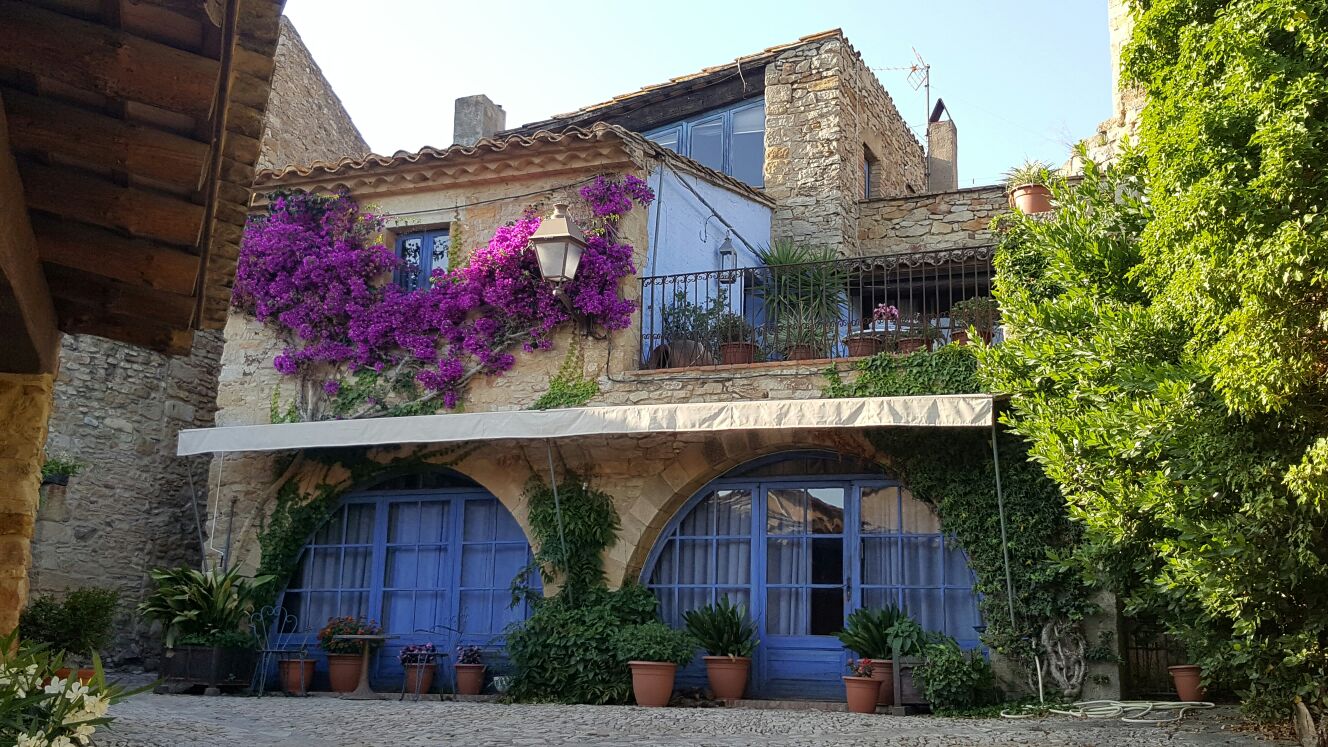
Apart from its architectural and historical attractions, the town is renowned for its significant artisan and, above all, gastronomic offer. The alleyways of the village are full of numerous and suggestive restaurants of all kinds, which offer the perfect complement to a visit to the village.
Peratallada has managed to preserve its rural character, while remaining faithful to its architectural and urban origins. It can be said that it has not expanded beyond the perimeter of the walls. The town still retains its medieval urban layout. From the square of Les Voltes, with its unique arcadings, to the plot of narrow streets, where you can discover a number of interesting elements of popular architecture. On older walls, the houses are still characteristic of the 16th century. The traditional houses of Peratallada usually have the ground floors lined with vaults made from stone, used as stores and cellars, while the upper floor is dedicated to living. There may still be another floor in the area of ??attic or barn and often a patio or ample access area at the back.
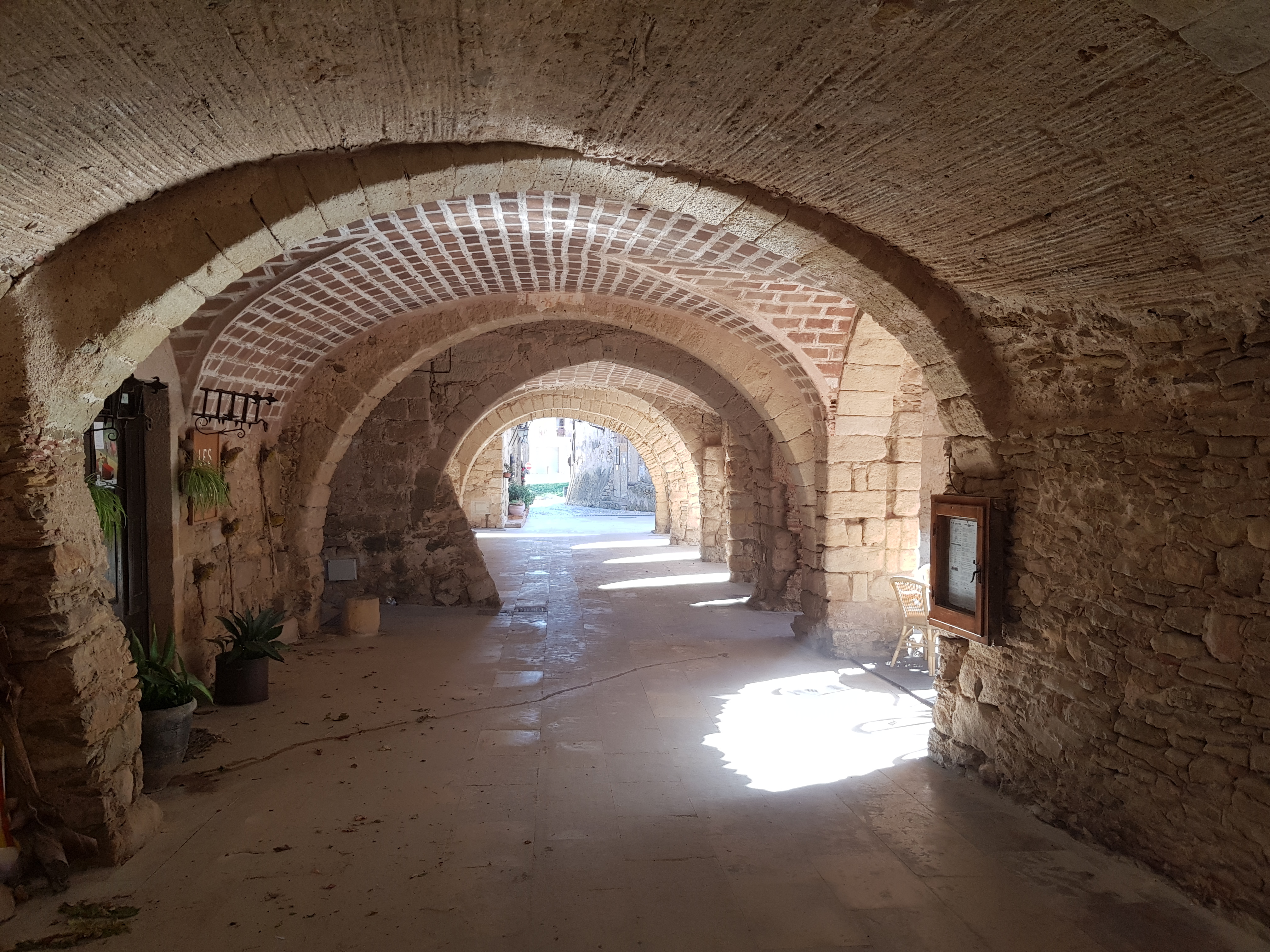
The place name Petra scissa or Petra Tallada is documented, apparently, from the 10th century. Later on, the name refers to a few modifications to the people or to the different characters of the Peratallada lineage, which eventually became one of the most significant in the Baix-Empordà roots. Thus, for example, in 1062 there is mention of a Bernardi de Patra Taliada, in 1065 Castro de Petra Taliata appears. In 1088 we find Petrataliata, 1111 Petra Taliata, 1112 Petra Talata, 1128 Petra Incisa and Patra Taiata, 1143 Petra Tayada, 1169 and 1173 Petra incisa, 1202 and 1222 Petricissa, etc...
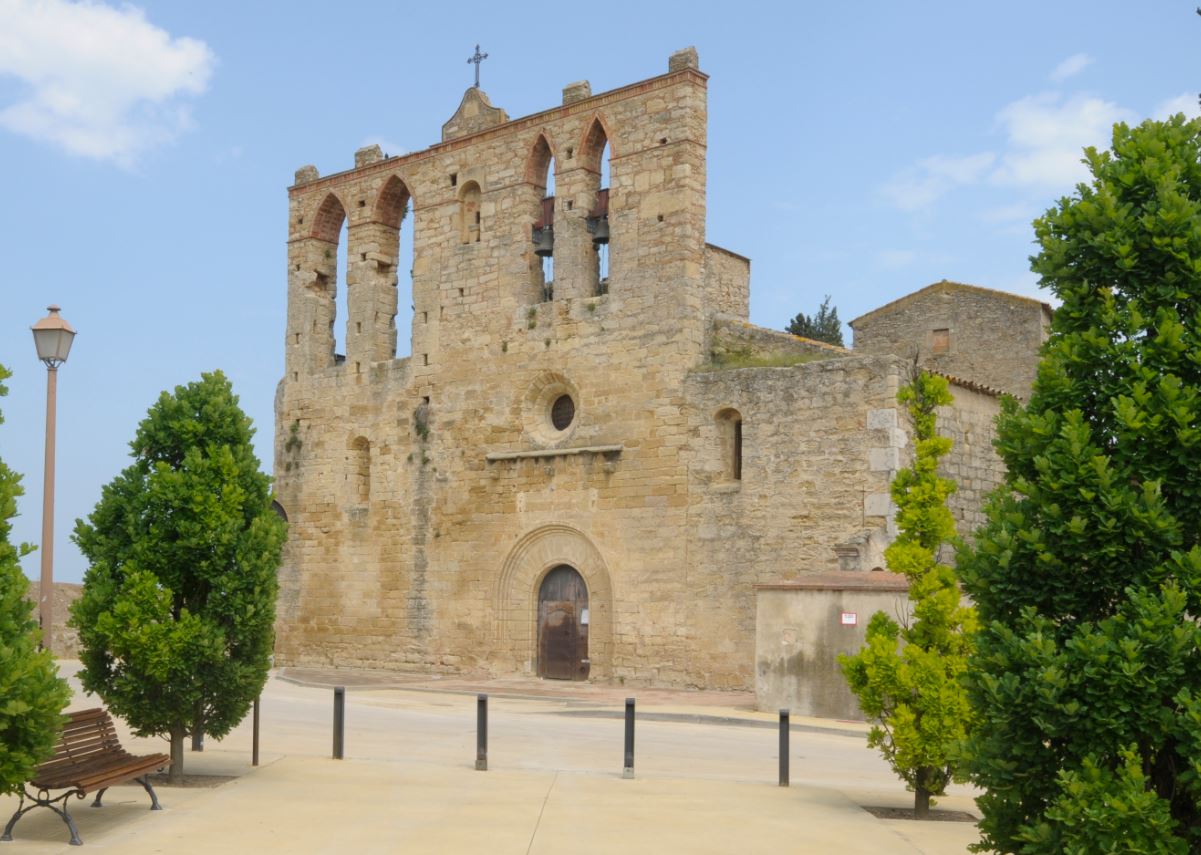
The church of Sant Esteve
This is a Romanesque temple with two naves raised to the east by semicircular apses, built with large square ashlars. On the façade the front door stands out, with a half-pointed arch, followed by mouldings, a simple rose window and three brackets that may have held beams of a porch that has disappeared. The Romanesque work has undergone several late alterations, which is evident above all in the interior. The front of the nave has a pointed vault with three toral arches; in the north one the vault is followed by a tubular section and another pointed one. At the moment, the interior of the building cannot be visited.
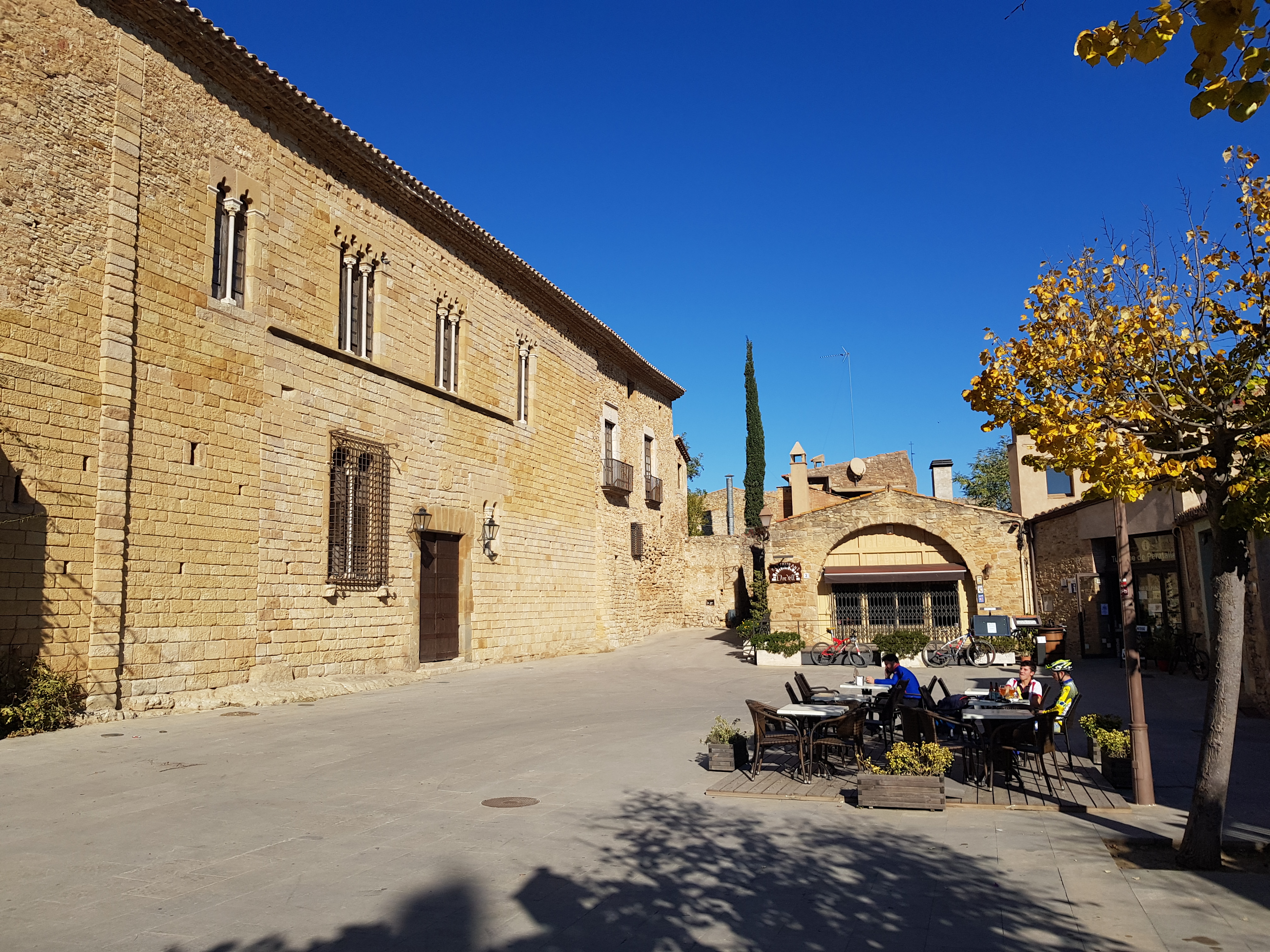
The castle-palace
It has been proved through documentary evidence that it already existed in 1065, but some architectural structures and other vestiges seem to show that in this place there had already been a fortress from much more distant times. It currently has constructive parts from different eras and styles. It is an extensive amalgam of buildings that make up one of the most interesting medieval castles and palaces in the country. This castle, which had been abandoned and finally sold by the descendants of the Cruïlles-Peratallada, served for years for the peasantry until the current owners, the counts of Torroella de Montgrí, began, in the vicinity of 1965, to rehabilitate it. In its present state, we can distinguish two sectors that are clearly differentiated by its structure and old use: the fortified village and the palace.
The fortified village or, defence, that is to say, the castle, is raised above an enormous rocky base of natural rock, artificially cut to give it verticality. The rocky mound, which rises 4 or 5 meters above ground, has two rectilinear sides and the others form unequal curves. Above that is the tribute tower, a true emblem of the town. The wall that surrounds the tower adapts to the irregular shape of the hill and conserves some battlements. The large ashlars of the wall that surrounds the tower could come from a construction from the early Roman or Visigothic period.
.jpg)
The schematic floor of the castle responds to the type of fortress of the late medieval period, very common in Carolingian times. In spite of everything, the existing architectural structure today is the result of later reconstructions. Romanesque work (C. XI-XII) can be considered as a good part of the walled enclosure, which still shows subsequent reforms. The remains of ancient settlements, before the medieval buildings that survive, are traced to the fortified village, but also to below: in the rear patio of the palace and below it. There are several foundations and a large number of cavities and grooves cut into the ground rock.
.jpg)
The palace is made up by different associated buildings that occupy a large area in the south-east and at a lower level of the defence village. It covers a complicated, irregular and scattered area. These constructions surround a central courtyard, but there are also other open spaces, closed, partly, by fence walls. The main façade of the palace is still on the east and occupies one side of the Castle Square. In the restoration works, the original structure was given back some of its openings. On the floor there are four large Gothic window frames with fine columns and capitals and arches on which there is a singular decoration.

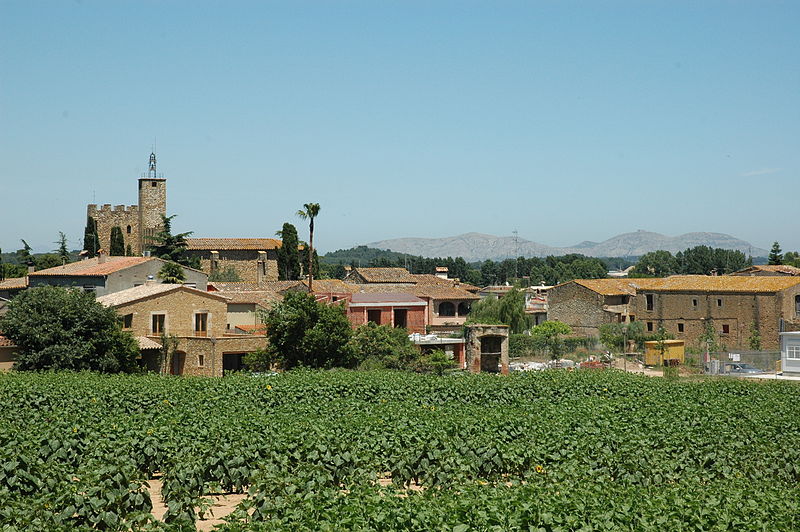
The old quarter was declared in 2009 by the Directorate General of Heritage of the Generalitat as a cultural asset of national interest in the historical group category. The town is made up of an old town with great architectural interest, which is structured around the elements that make up the castle-palace and the parish church of Sant Julià and Santa Basilissa.
The elements conserve a good part of the characteristics that are typical of the medieval Catalan towns. According to the text from the Government's agreement, the town "articulates throughout its grounds, a series of routes and spaces of architectural interest that invite contemplation and intrigue through the old town of this municipality", which "makes the integration and preservation of these historic elements especially necessary".
The parish church of Sant Julià and Santa Basilissa is the old chapel of the castle. The current building dates from the 16th century, with a late Gothic style, with Renaissance and fortified details. At the front, part of a late-medieval necropolis was excavated with anthropomorphic tombs and slabs that also extended below the temple and the subsoil of the castle, where there is a fragment of a decorated sarcophagus. Remnants have been found of the previous church, which could be Romanesque.
The castle-palace, for its part, largely maintains the essential structure of the 14th century, with numerous reforms from the first half of the 16th century, carried out by order of Miquel Sarriera, which affected the interior layout and decoration. By the year 1725, there were other reforms and later, the building was converted into a farmer's house. It is a two-storey building made up of three ravines, which, together with the church, frame a small interior patio with a trapezial area. In 1931 it was declared a national monument.
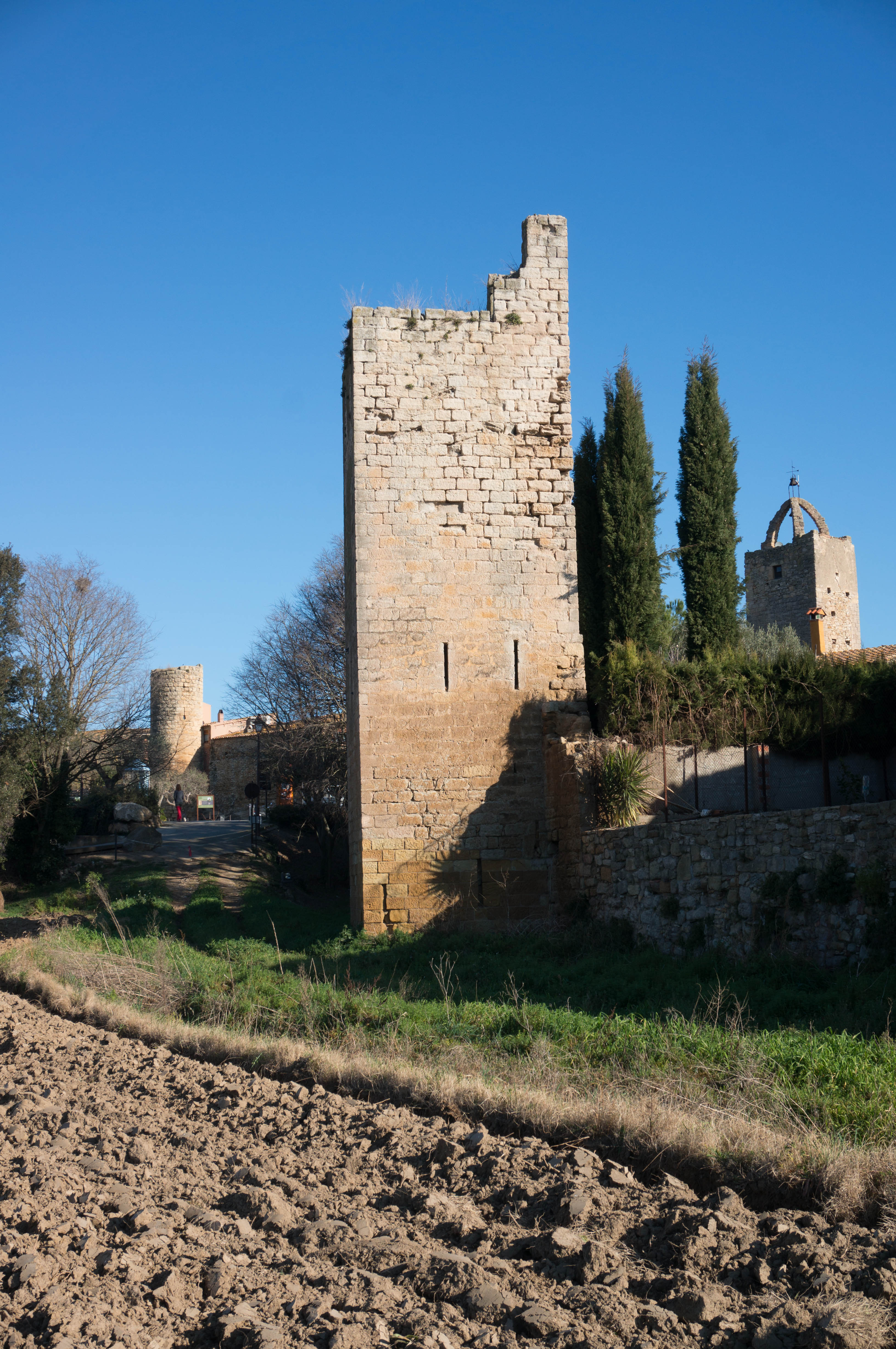
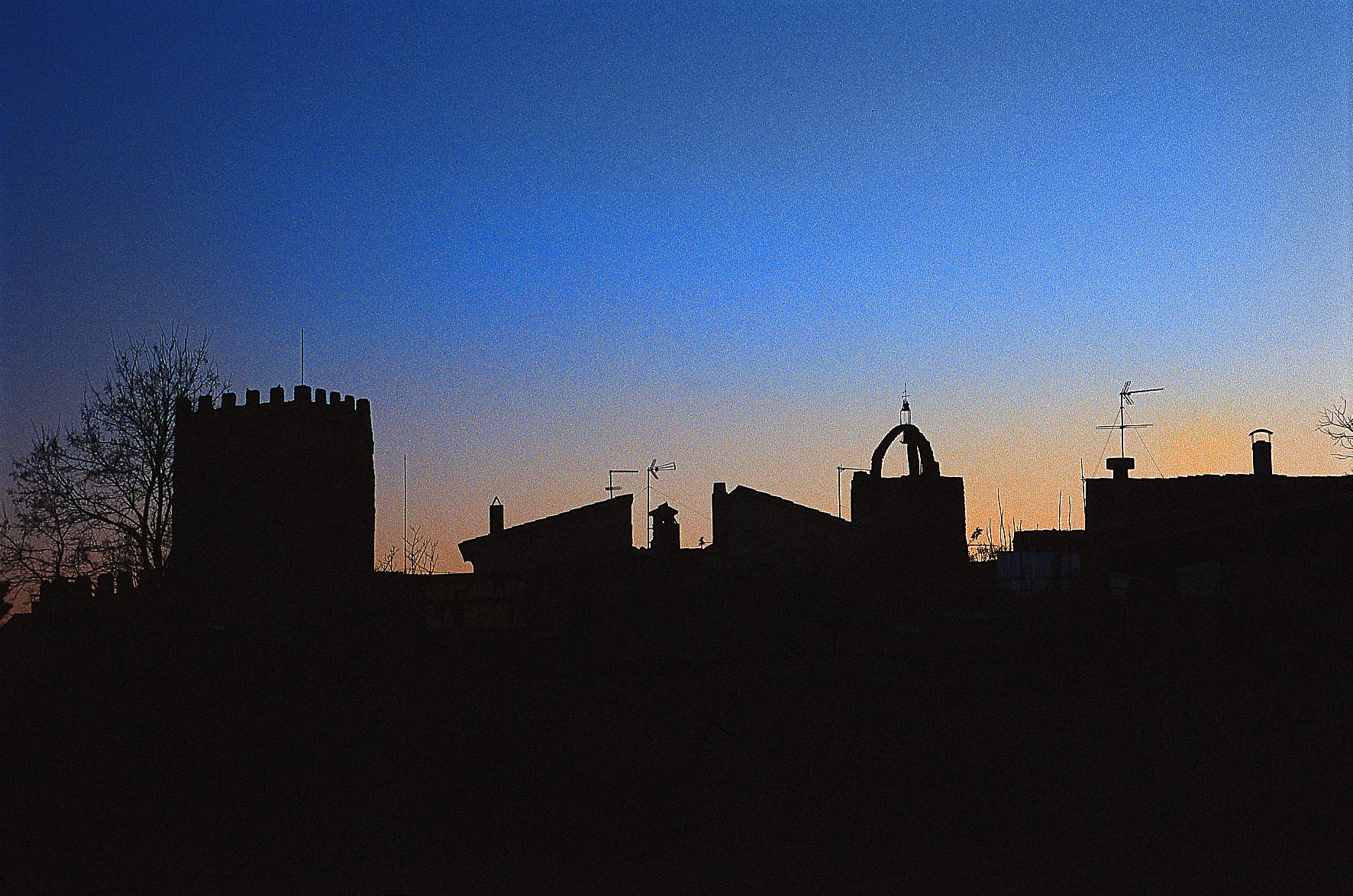
In the vicinity of the church and the palace there are scattered remnants of the wall, some remains of which are found in the houses of the village. The most well-preserved element is the north-east tower-portal, with a square floor plan and a sloping door. Another cylindrical tower to the south-west of the village is preserved, fitted between the houses.
There are some 17th and 18th century buildings that are of remarkable interest in terms of popular architecture on the northern alleyways in the Main Square, located outside the walls and in the main street, and where there are houses with voussoir portals, shields and some decorated windows. In the mountainous part of the municipality there are small areas with pine trees and holm oaks, and vineyards and olive groves. In the rest of the fields, mainly dry land, cereals, fodder and legumes are planted. There is a small sector with irrigation, which uses groundwater, dedicated to vegetables, corn and fodder. Poultry farms and breeding of beef and pork, with some derivative industrial activities, complete the economy.

Halfway between Peratallada and Vulpellac, the medieval elements of Canapost are made up of the church of Sant Esteve and the medieval necropolis with significant monolithic sarcophagus in sandstone.
If we approach the church of Sant Esteve de Canapost we can see the remains of a medieval cemetery discovered from the archaeological excavations carried out in this area.
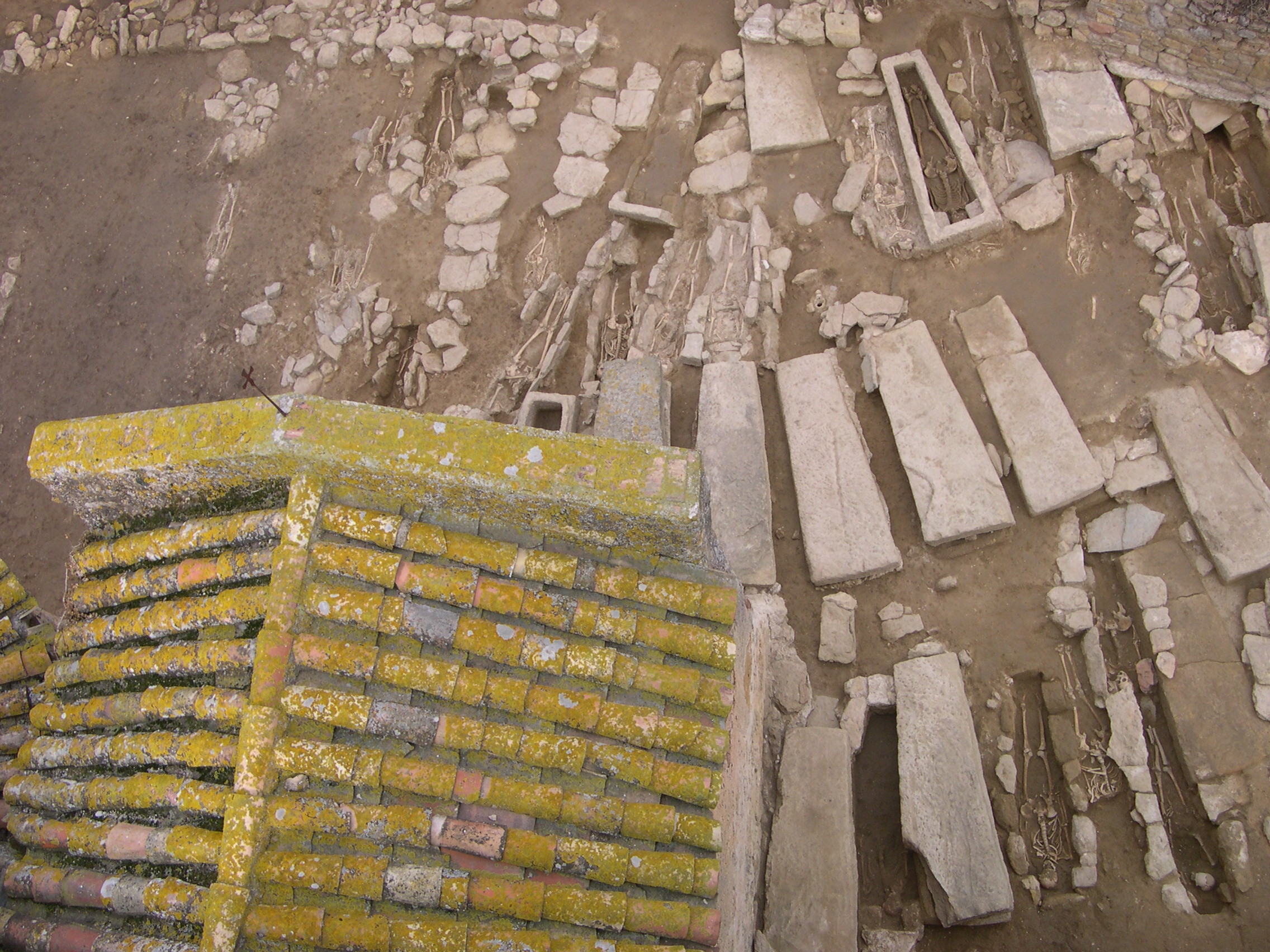
At the moment, the archaeological remains that can be seen correspond to a necropolis or cemetery from medieval times. However, on top of these remains, there was a part of a necropolis from modern times (16th-18th centuries). As it may be, the medieval necropolis, with an approximate dating of between the tenth and fifteenth centuries, was located in the vicinity of the church and under the burial site from modern times. The excavation process was complicated since many modern tombs partially cut through some medieval burial sites.
Between the months of November of 2004 and May of 2005, the City council realised an archaeological excavation around the church of Sant Esteve de Canapost that enabled them to locate 85 anthropomorphous tombs (in the form of a person) made with slabs and 18 sarcophagi carved into sandy rock that was very typical of the area.
All the visible tombs are medieval and during the excavation several ceramic pots were found next to the deceased and scallop shells, carried from Santiago de Compostela by a pilgrim more than 600 years ago.
This place is worth a visit to enjoy the peace and tranquillity that it breathes and to observe the discovered archaeological remains as it is one of the medieval necropolis with the most spectacular stone sarcophagi in the whole of Catalonia.
The church of Sant Esteve de Canapost is one of the most notable and perhaps unknown elements of our municipal heritage despite it being one of the architectural references of Romanesque Catalonia.
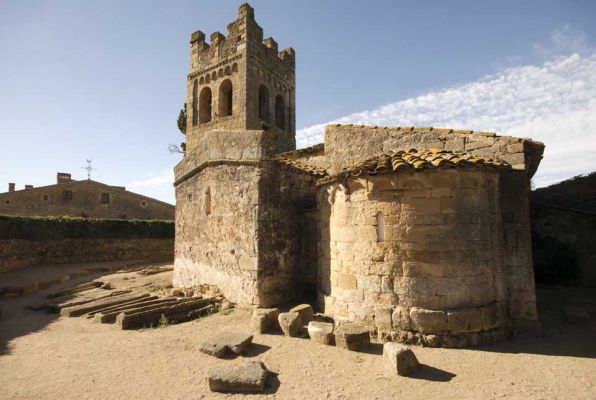
The church of Sant Esteve de Canapost is one of the most notable and perhaps unknown elements of our municipal heritage despite it being one of the architectural references of Romanesque Catalonia.
The church currently has two juxtaposed buildings, one is pre-Romanesque with a nave, a transept and a trapezial apse; and a Romanesque one with a semicircular apse. It is made up of three easily identifiable associated areas. The main area, in pre-Romanesque style, configures the nucleus of the church and was built around the 9th or 10th century. Its transept stands out, which is much higher than the nave's roof, with a well-marked horseshoe vault. Later, between the 11th and 12th centuries, the square designed bell tower was joined, to the south, and a parallel nave, to the north, in Romanesque style.
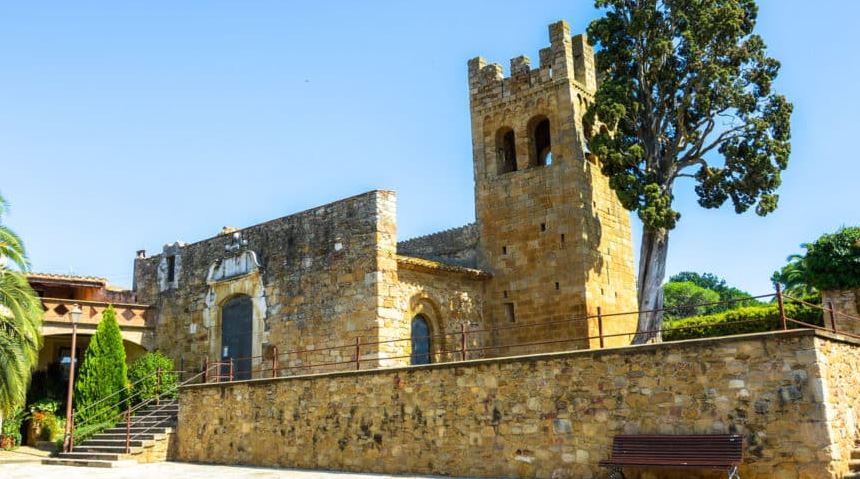
The front, where the door of the main entrance to the temple is now open, dates back to the 18th century and it was never finished. Indeed, behind the apses we can see, on the floor, the remains of the rose window that must have completed the façade. The church's invocation is dedicated to Sant Esteve and Sant Clet, the third pope of the Christian church that held office between 76 and 88. The church had a remarkable gothic altarpiece, of the Mare de Déu de Llet, that today is conserved in the Museum of Art in Girona. Next to the church there is a late medieval necropolis.
Romanesque paintings
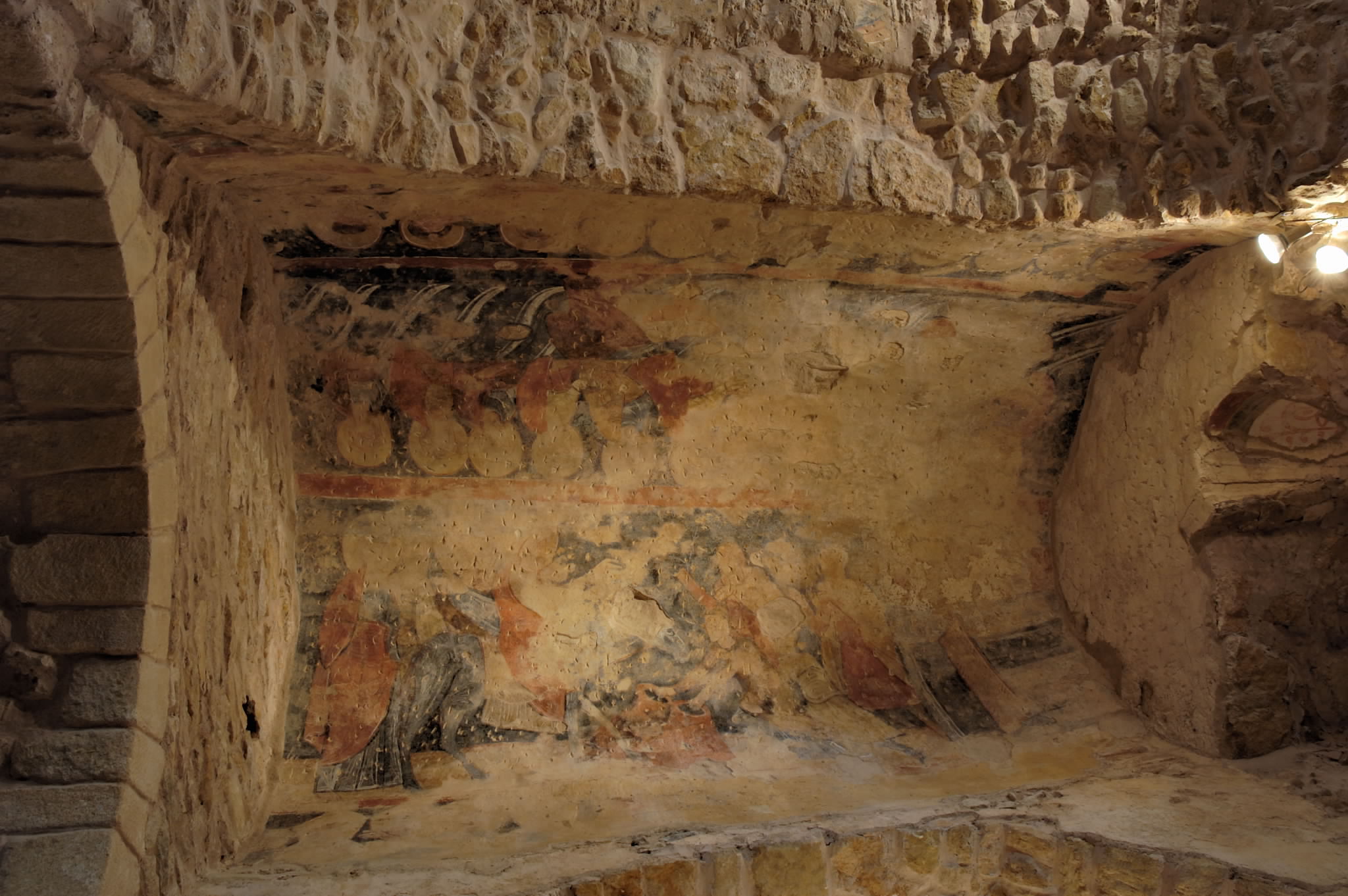
On the main altar and around the transept you can see remains of Romanesque paintings of extraordinary heritage value. In the eastern part you can glimpse a horse character, which could correspond to the biblical scene of the entrance of Jesus to Jerusalem and could date from the 12th century. On the opposite side, there is a scene of the Last Supper that experts place in the 15th century. They occupy about 10 square metres and were made from earth colours, made with the combination of iron oxide and lime minerals. The polychromes were discovered in 1999 as a result of some samples made from some pieces of paint located a long time ago. They were restored in 2002.

In addition to the historical and heritage value of the megalithic tombs and the church of Santa Coloma, Fitor, offers an unbeatable setting for the practice of activities related to active tourism: Cycling, mountain biking or hiking. Fitor is a special place, especially for those seeking tranquillity.
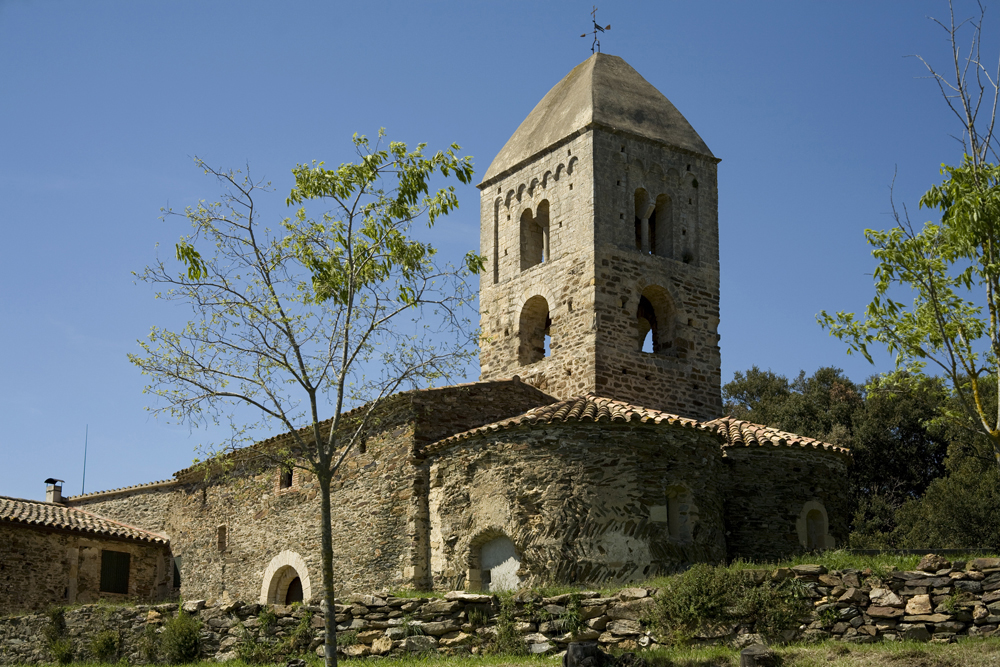
The church of Santa Coloma is one of the jewels of the Gavarres massif and without a doubt the most symbolic element of Fitor.
It is a Romanesque church, which stands majestic on a small plain that appears in the ridge formed by Puig d'Arriells and Puig Gros. The most singular and characteristic element of the building is its great bell tower, visible from most of the massif. It has a rectangular floor plan, with openings on all the three floors and a pyramidal roof covering four slopes. The openings on the upper floor are twin windows, with rounded arches, circular crossbones and trapezoidal capitals. This floor, which has been re-created, differs from the lower one, in terms of the era and constructive technique. Its vertical wall is made from sealed and polished ashlars with calcareous stone of regular dimensions, without oversized pieces on the edges. The Lombard influence of Catalan Romanesque is presented in the decoration of the windows on the upper floor of the bell tower, with an arcade frieze. Together with the rectory and the cemetery, it forms a small group.
In Fitor we can also find the densest dolmen village in the Gavarres area, and one of the main ones in Catalonia. The megaliths of the Gavarres were built at different times between 3400 and 2000 before Christ. Twenty-one have been counted in the whole of the massif, but Fitor is where more have been located.
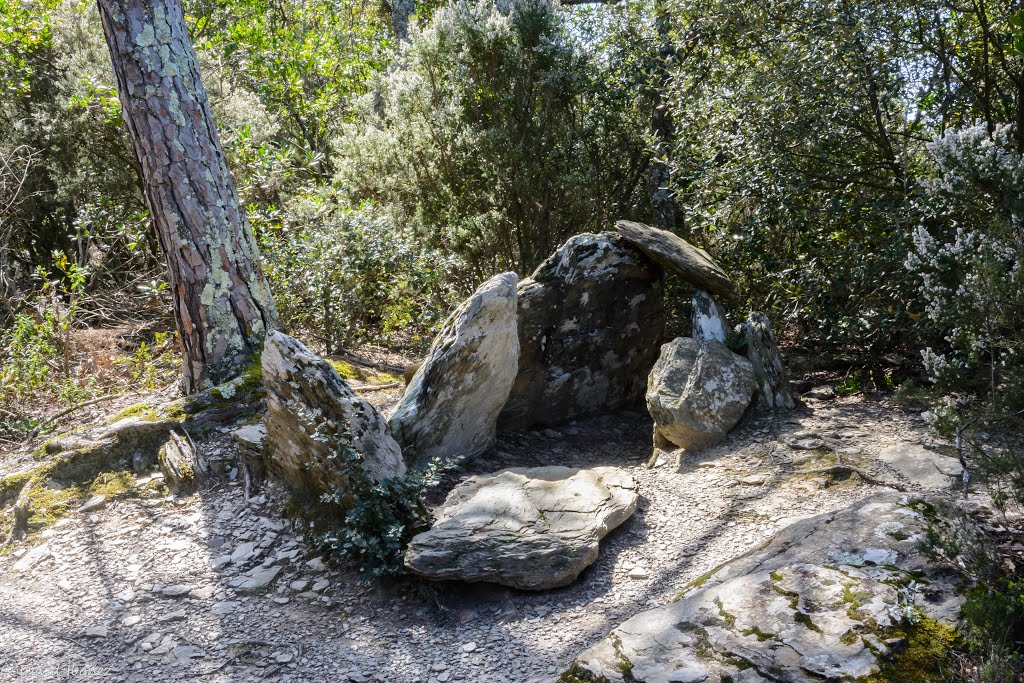
A significant number of these funerary constructions are still in a good state of preservation, made with large stone slabs, which show a good part of their original structure. At the end of Fitor there are fifteen dolmens, a menhir and several sacrifice stones. The best known are in the Serra de Cals, where the dolmen of Tres Peus, Tres Caires and the Serra de Calçó, are very well preserved, from which there are spectacular views of the Gavarres massif.
Dolmens were collective sepulchral enclosures designed to protect the bodies, located in elevated and dominant points, on the summits of hills or in well visible places. It has been proven that they were built with the intention that sunlight could reach the interior of the room, at least during the winter and summer solstices.
E-ROUTE 1: THE DOLMENS OF FITOR
A very easy circular route, ideal for small children or people with reduced mobility (not suitable for wheelchairs in the final section). This route of 1.62 km (45 minutes) and with an unevenness of 72 meters, allows us to visit the church of Santa Coloma de Fitor, the Mas Puig and the dolmen and the insculptures of the Llobinar.
Some good views can be enjoyed of the bell tower of Fitor with the Montgrí behind and the walk goes, to begin with, by the Camí Ral that linked the towns of Palamós and Girona. This route runs to a large extent through the land of Mas Joanola de Ramón Botey i Serra, please respect it.
The proposed itinerary leaves from Fitor, where the concentration of dolmens is the largest in the Baix Empordà. By car you can access it by following the wide forest trails that start from Mont-ras and Fonteta. To access Fitor on foot there is the PR-C 105 that allows you to reach it from Mont-ras and from Palamós, and there is also the PR-C from Fonteta. This route is part of the Baix Empordà hiking network, signalled within the framework of the Tourism Excellence Plan managed by the Baix Empordà Tourist Commission.
E-ROUTE 2: DOLMENS ROUTE OF THE SERRA D’EN CALS
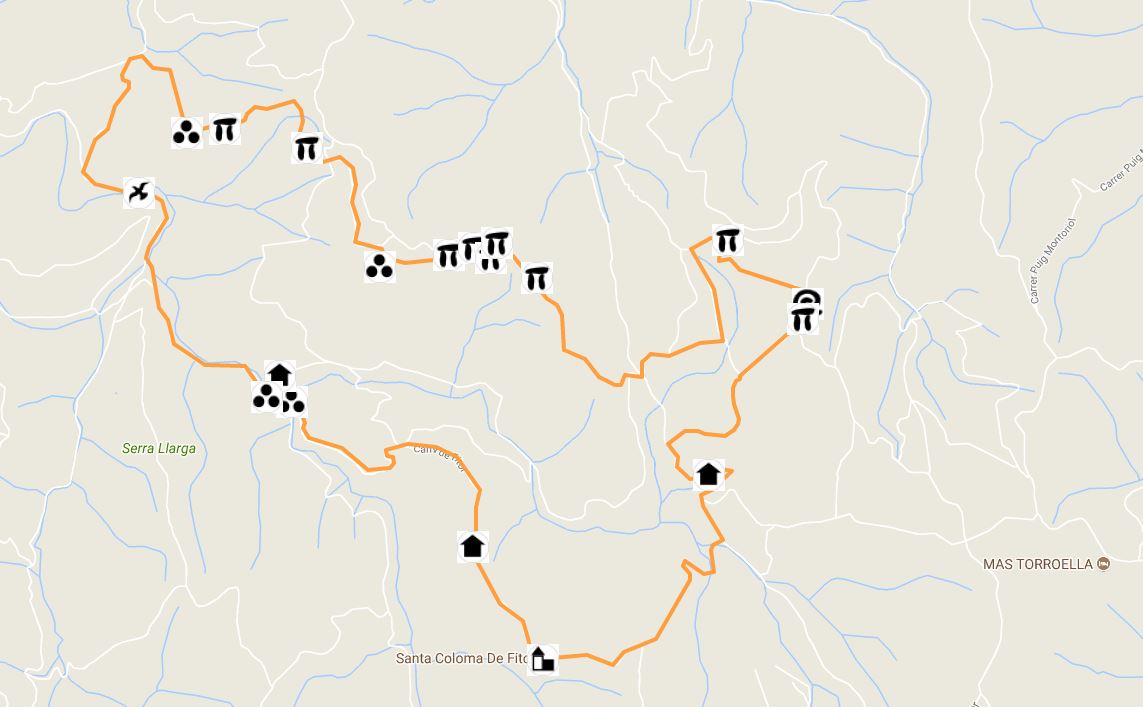
This is a circular route of moderate difficulty,10.38 km long, with a duration of 4 hours that runs through the Serra d'en Cals and the Serra Mitjana. With this route you can discover a great variety of megalithic presence in the northern part of the Gavarres with 10 megalithic monuments.
The proposed itinerary leaves from Fitor, where the concentration of dolmens is the largest in the Baix Empordà. By car you can access it by following the wide forest trails that start from Mont-ras and Fonteta. To access Fitor on foot there is the PR-C 105 that allows you to reach it from Mont-ras and from Palamós, and there is also the PR-C from Fonteta. This route is part of the Baix Empordà hiking network, signalled within the framework of the Tourism Excellence Plan managed by the Baix Empordà Tourist Commission.
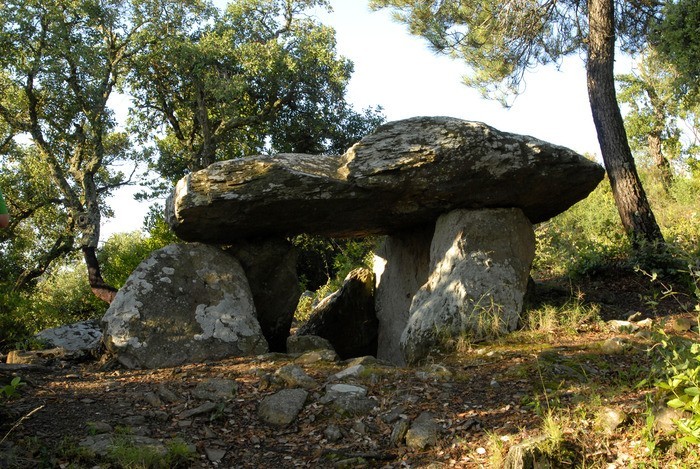
The route can be gently done in one morning, stopping to enjoy the surroundings and it is especially designed so that you can enter the natural environment and the history of the Gavarres, specifically in its prehistoric era.

The ethnological heritage of Forallac is made up of farms, springs, paths, lime kilns and ice wells. All of them are testimonies of the traditional activities of the exploitation of forests.
The springs have always been linked to the work and life of its inhabitants, they are from those magical places that have collected many events over time. There are many springs that exist in the Forallac area, particularly in the area of ??the municipality included in the area of ??the Gavarres massif. Some of them are very famous for the quality of the water. The geomorphological characteristics of the massif are the origin of the large number of existing springs. This fact is a legacy of great natural value and is an interesting attraction. The Gavarres are an area with granite and filonian rocks of almost zero porosity, where the few existing water reserves are associated with fractures, diasclasis or areas of alteration. This is a medium in which the water circulation is very slow, due to its low permeability, and where the water uses discontinuities of the terrain to circulate: faults, diasclasis, contact between different materials ... In fact, it is often observed how it is in these discontinuities where most of the sources are located.
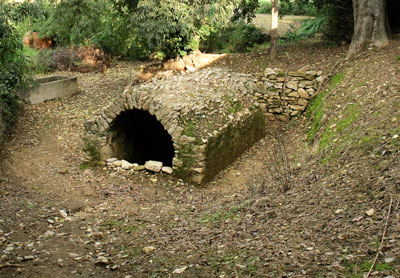
Fonteta Spring
Fonteta Spring is one of the most interesting springs of Forallac. It is considered by the inhabitants as the first spring, although over time it was forgotten because another was built in the church square. This spring contains water throughout the year and has a sandstone structure in the form of a vault with steps that give access to the water. There are public sinks nearby.
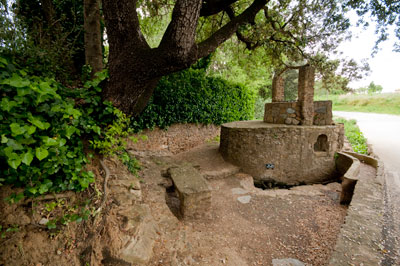
Santa Susanna Spring
The spring of Santa Susanna de Peralta, as it is now, was built in 1704, although historical documentation is available where it is mentioned long before that date. It is located under the protection of an impressive oak forest, just beside Peralta stream and the camí de Santa Susanna. It is a very welcoming place and it invites you to stay for a while at any time of the year, like the families who used to come to stay over for picnics. The water sprouted through a stone parapet that is almost buried. It was formerly used by the peasantry of the area.
Another of the most surprising resources for water use in the past is that of ice making. This industry is already documented in the Gavarres massif since the middle of the 16th century and reaches its maximum splendour between the middle of the 17th century and the end of the 18th century. In the Gavarres, the remains of eleven ice wells have been located.
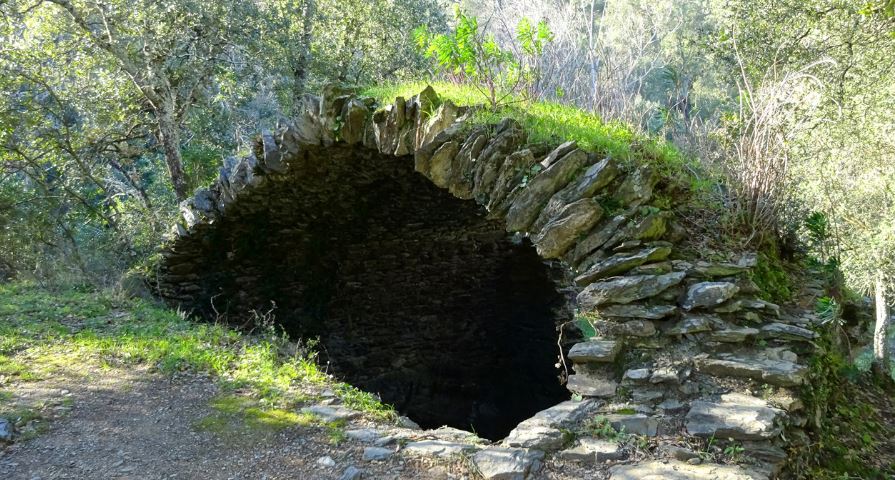
They are large structures, built on the north side with stone and covered with a stone vault. The activity of storing ice in an isolated area comes from the need to have ice throughout the year. Ice was a product of first necessity until the expansion of modern refrigeration systems, both for the preservation of food and its healing properties.
The most significant one in Forallac is probably that of Mas Cals de Fitor. It is a large underground tank that was used for more than 200 years to keep the ice from the winter freezing of the water from the stream of Mas Petit. At that time, due to a short ice age, it was much colder than now, which allowed the development of this ice industry. Probably, the business had a fairly positive return because the well was located at the foot of the Camí Ral which until the middle of the 19th century connected the port of Palamós and Girona. The well has a trapezoidal floor and was probably built in the 13th century.
In the districts of Fonteta and Sant Climent de Peralta there were also more than twenty lime kilns, four of which have disappeared altogether.
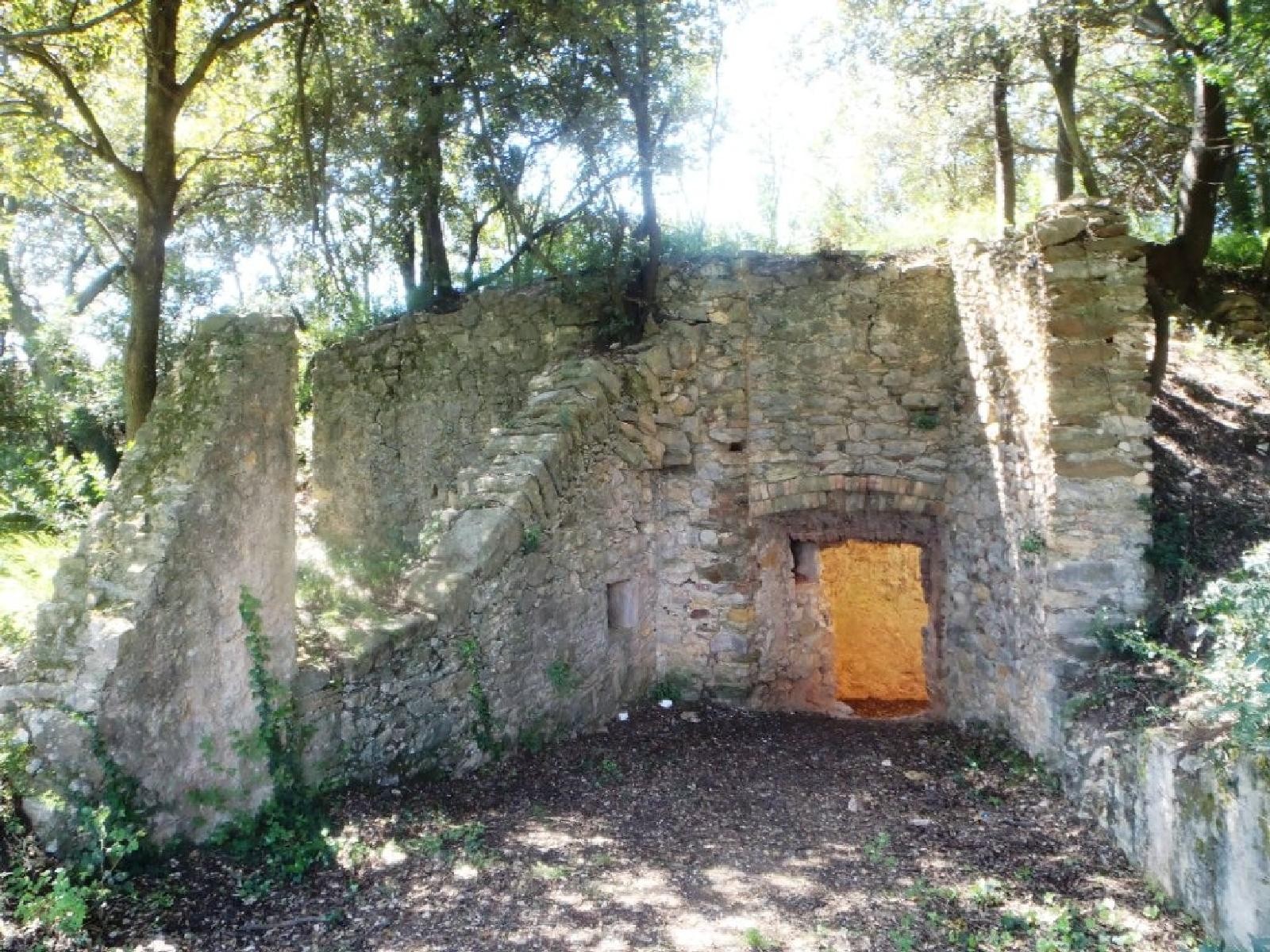
The others are still visible today, although they are in poor condition and in most cases covered with thick vegetation. Until the first third of our century, Forallac specialised in the manufacture of lime and had the ordinary demand of a very extensive region. Part of the lime was loaded by rail and boats and travelled to Barcelona. There are also the visible remains of many quarries always near to the kilns. Fifty years ago everybody from Fonteta and Sant Climent had some or other link with the lime industry: in woodworking, in the quarry, in the kilns, and lime shipment.
There were also many quarries, located very close to the kilns, in order to make the stone transport easier. In addition to the eight quarries we have located, there were other less significant ones that were opened in different places, as and when.

This is the old chapel of the castle-palace that is located just next to it, in the town of Vulpellac. The building dates from the 16th century, in a late Gothic style with Renaissance details and it is fortified. It is a one-nave building with exterior buttresses, a polygonal apse in the interior and semicircular on the outside, and a tiled roof on two sides. It has a very peculiar west façade, with large ashlars that are very well worked on the upper part, where two bells are hung. The access door is in the form of an ogival arc and has a lintel and a tympanum without decoration. The only ornamental elements of this door are the bases of the three arcades, with nature reliefs and persons heads. At the centre of the façade there is a simple rose window. The building is completed with pillars that serve as a base for a bell tower with an unfinished wall. The bell tower, which has a square base and is very stylized, rises up the north-west corner of the church. The interior, covered with a vault, conserves the Shield of the Sarriera in some projecting mouldings.

This is a Romanesque temple with two naves raised to the east by semicircular apses, built with large square ashlars. On the façade the front door stands out, with a half-pointed arch, followed by mouldings, a simple rose window and three brackets that may have held beams of a porch that has disappeared. The front of the nave has a pointed vault with three toral arches; in the north one the vault is followed by a tubular section and another pointed one. On the apse on this side a semicylindrical tower was erected that provides the monument with a very unique silhouette.

The current temple preserves the Romanesque nave, from the 11th century, which was later modified. The Romanesque apparatus can be seen on the western façade, where a Renaissance door and a rose window were opened. The barrel vault, which is plastered, must be the old cover. It is fortified and the Romanesque vault was replaced in the 18th century by a crucifix with a dome and a carved apse. The chapels were added later and the bell tower is from 1755. At the Museum of Art of Girona (old Diocese) there is a Renaissance gothic cross from Fonteta.

Surrounded by forests and fields, the church of Santa Susanna de Peralta is a small Romanesque temple with more than one thousand years of history and extraordinary beauty. The main features that give this building its personality are the bell tower with two half-pointed arches and the nave with a semicircular apse.
It is located about 200 metres north of the castle, in a hollow beside the right bank of the Peralta stream. It has a single nave with a semicircular apse that was the subject of remarkable reforms in the 17th and 18th centuries. It is in a good state of conservation thanks to the significant restoration that took place in 1976 and 1977. The apse is decorated with Lombard slats or lashes, and has a double-bottom window and rounded arches.
At the north side of the temple, at the far end of the nave, there is a square-bell tower that was unfinished or partly demolished. At the moment only the bottom part remains up to the height of the cover of the nave. On the east wall of this tower a bell tower was built with two rounded arches on rectangular pillars, also Romanesque. The interior of the bell tower is connected to the nave by means of a mid-point arch, from the baroque period.

This is one of the jewels of the Gavarres massif. It is a Romanesque church, which stands majestic on a small plain that appears in the ridge formed by Puig d'Arriells and Puig Gros. The most singular and characteristic element of the building is its great bell tower, visible from most of the massif. It has a rectangular floor plan, with openings on all the three floors and a pyramidal roof covering four slopes.
The openings on the upper floor are twin windows, with rounded arches, circular crossbones and trapezoidal capitals. This floor, which has been re-created, differs from the lower one, in terms of the era and constructive technique. Its vertical wall is made from sealed and polished ashlars with calcareous stone of regular dimensions, without oversized pieces on the edges.
The Lombard influence of Catalan Romanesque is presented in the decoration of the windows on the upper floor of the bell tower, with an arcade frieze. Together with the rectory and the cemetery, it forms a small isolated ensemble.
It has two naves covered by two semicircular apses. It seems that the oldest one is at the front, the apse of which has an apparatus in the form of a spike and the nave has the remains of Romanesque mural paintings. The pointed vault is at the rear. On the threshold of the entrance to the church is the tombstone of the rector who died in 1817, at the hands of bandits who plundered the church. It can be read, in non-academic Latin, how he died.
The act of consecration
In 1989 a copy of the endowment text or the act of consecration of the church was discovered in the Capitular Archive of Girona, which Guillem Molas made in the 18th century. Thanks to this document, we know that on 29 January 948, Bishop Gotmar of Girona came to Fitor to consecrate the church, which had been built by the presbyter Altimir and the Levites Placià and Tassi, with the help of all the faithful. The new church was given, as it was the custom, a diversity of elements from different people. The donations consisted of land, vineyards and "mountains".

This is one of the most important buildings in the Catalan Romanesque style. It is made up of three easily identifiable associated areas. The main area, in pre-Romanesque style, configures the nucleus of the church and was built around the 9th or 10th century. Its transept stands out, which is much higher than the nave's roof, with a well-marked horseshoe vault. Later, between the 11th and 12th centuries, the square designed bell tower was joined, to the south, and a parallel nave, to the north, in Romanesque style.
The front, where the door of the main entrance to the temple is now open, dates back to the 18th century and it was never finished. Indeed, behind the apses we can see, on the floor, the remains of the rose window that must have completed the façade. The church's invocation is dedicated to Sant Esteve and Sant Clet, the third pope of the Christian church that held office between 76 and 88.
The church had a remarkable gothic altarpiece, of the Mare de Déu de Llet, that today is conserved in the Museum of Art in Girona. Next to the church there is a late medieval necropolis.
Romanesque paintings
On the main altar and around the transept you can see remains of Romanesque paintings of extraordinary heritage value. In the eastern part you can glimpse a horse character, which could correspond to the biblical scene of the entrance of Jesus to Jerusalem and could date from the 12th century. On the opposite side, there is a scene of the Last Supper that experts place in the 15th century. They occupy about 10 square metres and were made from earth colours, made with the combination of iron oxide and lime minerals. The polychromes were discovered in 1999 as a result of some samples made from some pieces of paint located a long time ago. They were restored in 2002.

The remains of the Mare de Déu dels Socors evoke the beauty and majesty of one of the most unknown temples of our architectural heritage. This singular chapel, dating from the 17th century, is located on the west side of Canapost, on the hill that gives it its name. It was all backed with a defence tower attached to the rear, and lost the roof and part of the stones that formed the openings, most likely as a result of a plundering. Despite its charm and value, it is a rather unknown element, which is not found in any of the tourist guides in the area. A visit is highly recommended, especially because of its privileged location, from which there are magnificent views. Josep Pla considered it one of the most privileged viewpoints of the Empordà.

This was built two kilometres north of the old quarter (deeper within the Gavarres massif), in a less remote place than most of the many farms that are spread through the area. It can be easily seen from the road from Girona to Palamós. The parochial temple is an 18th century building, with a nave with side chapels and a polygonal chancel. On the western façade there is the rectangular limestone portal. It is decorated with a pediment and hemispheres in relief. There is a niche, now without an image, and above it in circular relief, the IHS anagram. We can also see the inscription that informs us of the time when it was built: (begun 1737 - completed 1751).